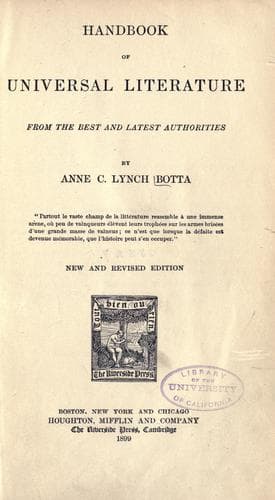
Handbook of Universal Literature, From the Best and Latest AuthoritiesBotta, Anne C. Lynch (Anne Charlotte Lynch)
History
Handbook of Universal Literature, From the Best and Latest Authorities
Botta, Anne C. Lynch (Anne Charlotte Lynch)
Literature -- History and criticism
Martial (43-104 A.D.) was born in Spain. He early emigrated to Rome, where
he became a favorite of Titus and Domitian, and in the reign of the latter
he was appointed to the office of court-poet. During thirty-five years, he
lived at Rome the life of a flatterer and a dependent, and then he
returned to his native town, where his death was hastened by his distaste
for provincial life. Measured by the corrupt standard of morals which
disgraced the age in which he lived, Martial was probably not worse than
most of his contemporaries; for the fearful profligacy, which his powerful
pen describes in such hideous terms, had spread through Rome its loathsome
infection. Had he lived in better times, his talents might have been
devoted to a purer object; as it was, no language is strong enough to
denounce the impurities of his page, and his moral taste must have been
thoroughly depraved not to have turned with disgust from the contemplation
of such subjects. But not all his poems are of this character. Amidst some
obscurity of style and want of finish, many are redolent of Greek
sweetness and elegance. Here and there are pleasing descriptions of the
beauties of nature, and many are kind-hearted and full of varied wit,
poetical imagination, and graceful expression. To the original
characteristics of the Greek epigram, Martial, more than any other poet,
added that which constitutes an epigram in the modern sense of the term:
pointedness either in jest or earnest, and the bitterness of personal
satire.
4. DRAMATIC LITERATURE.--Dramatic literature never flourished in Rome, and
still less under the empire. During this period there were not wanting
some imitators of Greece in this noble branch of poetry, but their
productions were rather literary than dramatic; they were poems composed
in a dramatic form, intended to be read, not acted. They contain noble
philosophical sentiments, lively descriptions, and passages full of
tenderness and pathos, but they are deficient in dramatic effect, and
positively offend against those laws of good taste which regulated the
Athenian stage. In the Augustan age, a few writers attained some
excellence in tragedy, at least in the opinion of ancient critics.
Under the tyrant Nero, dramatic literature reappeared, specimens of which
are extant in the ten tragedies attributed to Seneca. But the genius of
the author never grasps, in their wholeness, the characters which he
attempts to copy; they are distorted images of the Greek originals, and
the shadowy grandeur of the godlike heroes of Aeschylus stands forth in
corporeal vastness, and appears childish and unnatural, like the giants of
a story-book. The Greeks believed in the gods and heroes whose agency and
exploits constituted the machinery of tragedy, but the Romans did not, and
we cannot sympathize with them, because we see that they are insincere.
Public-domain text, read in full here on John Shaqi.
Reviews
Reviews
No reviews yet
Be the first to share your thoughts on this work.
Elsewhere in the archive
Join the Discussion
Join the discussion
Sign in to leave a comment or review.
Sign InorCreate an account