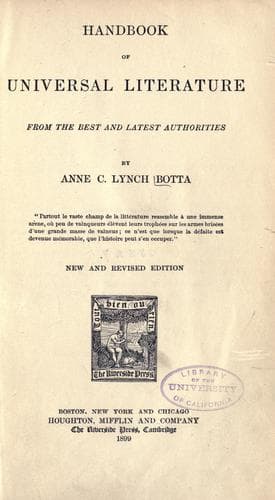
Handbook of Universal Literature, From the Best and Latest AuthoritiesBotta, Anne C. Lynch (Anne Charlotte Lynch)
History
Handbook of Universal Literature, From the Best and Latest Authorities
Botta, Anne C. Lynch (Anne Charlotte Lynch)
Literature -- History and criticism
The only one of his works which survives is the "Pharsalia," an epic poem
on the subject of the civil war between Caesar and Pompey. It bears
evident marks of having been left unfinished; it has great faults and at
the same time great beauties. The sentiments contained in this poem
breathe a love of freedom and an attachment to the old Roman
republicanism. Its subject is a noble one, full of historic interest, and
it is treated with spirit, brilliancy, and animation. The characters of
Caesar and Pompey are masterpieces; but while some passages are scarcely
inferior to any written by the best Latin poets, others have neither the
dignity of prose, nor the melody of poetry. Description forms the
principal feature in the poetry of Lucan; in fact, it constitutes one of
the characteristic features of Roman literature in its decline, because
poetry had become more than ever an art, and the epoch one of erudition.
Silius Italicus (fl. 54 A.D.) was the favorite and intimate of two
emperors, Nero and Vitellius. He left a poem, the "Punica," which contains
the history in heroic verse of the second Punic war. The Aeneid of Virgil
was his model, and the narrative of Livy furnished his materials. It is
considered the dullest and most tedious poem in the Latin language though
its versification is harmonious, and will often, in point of smoothness,
bear comparison with that of Virgil.
Valerius Flaccus flourished in the reign of Vespasian. He is author of the
"Argonautica," an imitation and in some parts a translation of the Greek
poem of Apollonius Rhodius on the same subject. He evidently did not live
to complete his original design. In the Argonautica there are no glaring
faults or blemishes, but there is also no genius, no inspiration. He has
some talents as a descriptive poet; his versification is harmonious and
his style graceful.
P. Statius (61-95 A.D.) was the author of the Silviae, Thebaid, and
Achilleid. The "Silviae" are the rude materials of thought springing up
spontaneously in all their wild luxuriance, from the rich, natural soil of
the imagination of the poet. The subject of the "Thebaid" is the ancient
Greek legend respecting the war of the Seven against Thebes, and the
"Achilleid" was intended to embrace all the exploits of Achilles, but only
two books were completed. The poems of Statius contain many poetical
incidents, which might stand by themselves as perfect fugitive pieces. In
these we see his natural and unaffected elegance, his harmonious ear, and
the truthfulness of his perceptions. But, as an epic poet, he has neither
grasp of mind nor vigor of conception; his imaginary heroes do not inspire
and warm his imagination; and his genius was unable to rise to the highest
departments of art.
Public-domain text, read in full here on John Shaqi.
Reviews
Reviews
No reviews yet
Be the first to share your thoughts on this work.
Elsewhere in the archive
Join the Discussion
Join the discussion
Sign in to leave a comment or review.
Sign InorCreate an account