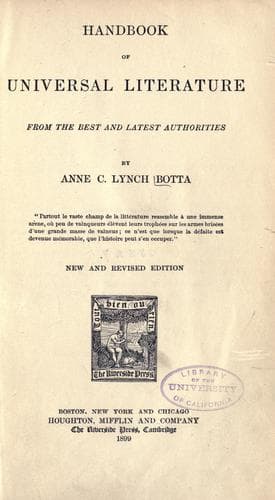
Handbook of Universal Literature, From the Best and Latest AuthoritiesBotta, Anne C. Lynch (Anne Charlotte Lynch)
History
Handbook of Universal Literature, From the Best and Latest Authorities
Botta, Anne C. Lynch (Anne Charlotte Lynch)
Literature -- History and criticism
An awful belief in destiny, and the hopeless yet patient struggle of a
great and good man against this all-ruling power, are the mainspring of
Greek tragedy. This belief the Romans did not transfer into their
imitations, but they supplied its place with the stern fatalism of the
Stoics. The principle of destiny entertained by the Greek poets is a
mythological, even a religious one. It is the irresistible will of God.
God is at the commencement of the chain of causes and effects, by which
the event is brought about which God has ordained; his inspired prophets
have power to foretell, and mortals cannot resist or avoid. It is rather
predestination than destiny. The fatalism of the Stoics, on the other
hand, is the doctrine of practical necessity. It ignores the almighty
power of the Supreme Being, and although it does not deny his existence,
it strips him of his attributes as the moral governor of the universe.
These doctrines, expressed equally in the writings of Seneca the
philosopher, and in the tragedies attributed to him, lead to the
probability, amounting almost to certainty, that he was their author. But
whatever be the case in regard to their authorship, it is certain that,
notwithstanding their false rhetorical taste and the absence of all ideal
and creative genius, they have found many admirers and imitators in modern
times. The French school of tragic poets took them for their model;
Corneille evidently considered them the ideal of tragedy, and Racine
servilely imitated them.
5. EPIC POETRY.--At the head of the epic poets who flourished during the
Silver Age, stands Lucan (39-66 A.D.). He was born at Cordova, in Spain,
and probably came to Rome when very young, where his literary reputation
was soon established. But Nero, who could not bear the idea of a rival,
forbade him to recite his poems, then the common mode of publication.
Neither would he allow him to plead as an advocate. Smarting under this
provocation, he joined in a conspiracy against the emperor's life. The
plot failed, but Lucan was pardoned on condition of pointing out his
confederates, and in the vain hope of saving himself from the monster's
vengeance, he actually impeached his mother. This noble woman was
incapable of treason. Tacitus says, "the scourge, the flames, the rage of
the executioners who tortured her the more savagely, lest they should be
scorned by a woman, were powerless to extort a false confession." Lucan
never received the reward which he purchased by treachery. When the
warrant for his death was issued, he caused his veins to be cut asunder,
and expired in the twenty-seventh year of his age.
Public-domain text, read in full here on John Shaqi.
Reviews
Reviews
No reviews yet
Be the first to share your thoughts on this work.
Elsewhere in the archive
Join the Discussion
Join the discussion
Sign in to leave a comment or review.
Sign InorCreate an account