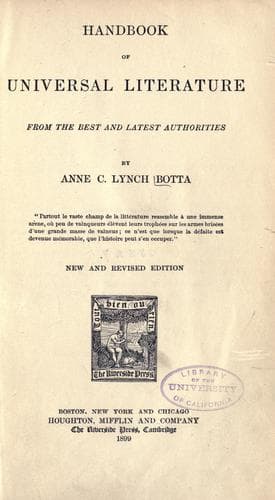
Handbook of Universal Literature, From the Best and Latest AuthoritiesBotta, Anne C. Lynch (Anne Charlotte Lynch)
History
Handbook of Universal Literature, From the Best and Latest Authorities
Botta, Anne C. Lynch (Anne Charlotte Lynch)
Literature -- History and criticism
Tacitus (60-135 A.D.) was of equestrian rank, and served in several
important offices of the empire. His works now extant are a life of his
father-in-law, Agricola, a tract on the manners and nations of the
Germans, a small portion of a voluminous work entitled "Histories," about
two thirds of another historical work, entitled "Annals," and a dialogue
on the decline of eloquence. The life of Agricola, though a panegyric
rather than a biography, is a beautiful specimen of the vigor and force of
expression with which this greatest painter of antiquity could throw off
any portrait which he attempted. Even if the likeness be somewhat
flattered, the qualities which the writer possessed, his insight into
character, his pathetic power, and his affectionate heart, render this
short piece one of the most attractive biographies extant. The treatise on
the "Geography, Manners, and Nations of Germany," though containing
geographical descriptions often vague and inaccurate, and accounts
evidently founded on mere tales of travelers, bears the impress of truth
in the salient points and characteristic features of the national manners
and institutions of Teutonic nations. The "Histories," his earliest
historical work, of which only four books and a portion of the fifth are
extant, extended from the year 69 to 96 A.D., and it was his intention to
include the reigns of Nero and Trajan. In this work he proposed to
investigate the political state of the commonwealth, the feeling of its
armies, the sentiments of its provinces, the elements of its strength and
weakness, and the causes and reasons for each historical phenomenon. The
principal fault which diminishes the value of his history as a record of
events is his too great readiness to accept evidence unhesitatingly, and
to record popular rumors without taking sufficient pains to examine into
their truth. His incorrect account of the history, constitution, and
manners of the Jewish people is one among the few instances of this fault,
scattered over a vast field of faithful history. The "Annals" consist of
sixteen books; they begin with the death of Augustus, and conclude with
that of Nero (14-68 A.D.). The object of Tacitus was to describe the
influence which the establishment of tyranny on the ruins of liberty
exercised for good or for evil in bringing out the character of the
individual. In the extinction of freedom there still existed in Rome
bright examples of heroism and courage, and instances not less prominent
of corruption and degradation. In the annals of Tacitus these individuals
stand out in bold relief, either singly or in groups upon the stage, while
the emperor forms the principal figure, and the moral sense of the reader
is awakened to admire instances of patient suffering and determined
bravery, or to witness abject slavery and remorseless despotism.
Public-domain text, read in full here on John Shaqi.
Reviews
Reviews
No reviews yet
Be the first to share your thoughts on this work.
Elsewhere in the archive
Join the Discussion
Join the discussion
Sign in to leave a comment or review.
Sign InorCreate an account