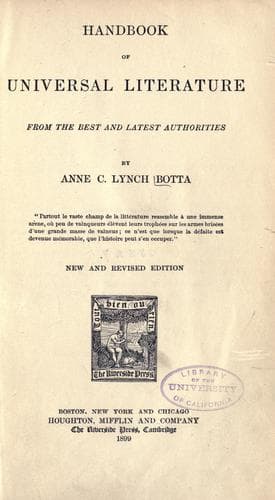
Handbook of Universal Literature, From the Best and Latest AuthoritiesBotta, Anne C. Lynch (Anne Charlotte Lynch)
History
Handbook of Universal Literature, From the Best and Latest Authorities
Botta, Anne C. Lynch (Anne Charlotte Lynch)
Literature -- History and criticism
Full of sagacious observation and descriptive power, Tacitus engages the
most serious attention of the reader by the gravity of his condensed and
comprehensive style, as he does by the wisdom and dignity of his
reflections. Living amidst the influences of a corrupt age, he was
uncontaminated. By his virtue and integrity, and his chastened political
liberality, he commands our admiration as a man, while his love of truth
is reflected in his character as a historian. In his style, the form is
always subordinate to the matter; his sentences are suggestive of far more
than they express, and his brevity is enlivened by copiousness, variety,
and poetry; his language is highly figurative; his descriptions of scenery
and incidents are eminently picturesque, his characters dramatic, and the
expression of his own sentiments almost lyrical.
Suetonius was born about 69 A.D. His principal extant works are the "Lives
of the Twelve Caesars," "Notices of Illustrious Grammarians and
Rhetoricians," and the Lives of the Poets Terence, Horace, Persius, Lucan,
and Juvenal. The use which he makes of historical documents proves that he
was a man of diligent research, and, as a biographer, industrious and
careful. He indulges neither in ornament of style nor in romantic
exaggeration. The pictures which he draws of some of the Caesars are
indeed terrible, but they are fully supported by the contemporary
authority of Juvenal and Tacitus. As a historian, Suetonius had not that
comprehensive and philosophical mind which would qualify him for taking an
enlarged view of his subject; he has no definite plan or method, and
wanders at will from one subject to another just as the idea seizes him.
Curtius is considered by some writers as belonging to the Silver Age, and
by others to a later period. His biography of Alexander the Great is
deeply interesting. It is a romance rather than a history. He never loses
an opportunity, by the coloring which he gives to historical facts, of
elevating the Macedonian conqueror to a super-human standard. His florid
and ornamented style is suitable to the imaginary orations which are
introduced in the narrative, and which constitute the most striking
portions of the work.
Valerius Maximus flourished during the reign of Tiberius. His work is a
collection of anecdotes entitled "Memorable Sayings and Deeds," the object
of which was to illustrate by examples the beauty of virtue and the
deformity of vice. The style is prolix and declamatory, and characterized
by awkward affectation and involved obscurity.
Public-domain text, read in full here on John Shaqi.
Reviews
Reviews
No reviews yet
Be the first to share your thoughts on this work.
Elsewhere in the archive
Join the Discussion
Join the discussion
Sign in to leave a comment or review.
Sign InorCreate an account