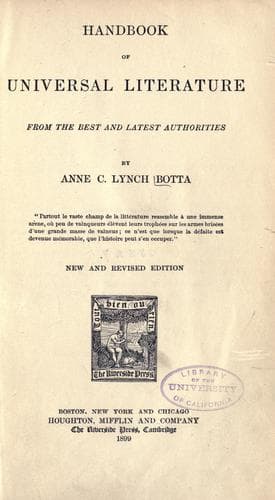
Handbook of Universal Literature, From the Best and Latest AuthoritiesBotta, Anne C. Lynch (Anne Charlotte Lynch)
History
Handbook of Universal Literature, From the Best and Latest Authorities
Botta, Anne C. Lynch (Anne Charlotte Lynch)
Literature -- History and criticism
Among the pupils of Quintilian, Pliny the younger took the highest place
in the literature of his age. He was born in Como, 61 A.D., and adopted
and educated by his maternal uncle, the elder Pliny. He attained great
celebrity as a pleader, and stood high in favor with the emperor. His
works consist of a panegyric on Trajan, and a collection of letters in ten
books. The panegyric is a piece of courtly flattery in accordance with the
cringing and fawning manners of the times. The letters are very valuable,
not only for the insight which they give into his own character, but also
into the manners and modes of thought of his illustrious contemporaries,
as well as the politics of the day. For liveliness, descriptive power,
elegance, and simplicity of style, they are scarcely inferior to those of
Cicero, whom he evidently took for his model. These letters show how
accurate and judicious was the mind of Pliny, how prudent his
administration in the high offices which he filled under the reign of
Trajan, and how refined his taste for the beautiful. The tenth book, which
consists of the letters to Trajan, together with the emperor's rescripts,
will be read with the greatest interest. The following passages from his
dispatch respecting the Christians, written while he was procurator of the
province of Bithynia, and the emperor's answer, are worthy of being
transcribed, both because reference is so often made to them, and because
they throw light upon the marvelous and rapid propagation of the gospel,
the manners of the early Christians, the treatment to which their
constancy exposed them, and the severe jealousy with which they were
regarded:--
Public-domain text, read in full here on John Shaqi.
Reviews
Reviews
No reviews yet
Be the first to share your thoughts on this work.
Elsewhere in the archive
Join the Discussion
Join the discussion
Sign in to leave a comment or review.
Sign InorCreate an account