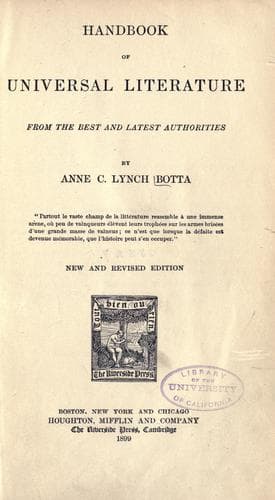
Handbook of Universal Literature, From the Best and Latest AuthoritiesBotta, Anne C. Lynch (Anne Charlotte Lynch)
History
Handbook of Universal Literature, From the Best and Latest Authorities
Botta, Anne C. Lynch (Anne Charlotte Lynch)
Literature -- History and criticism
7. RHETORIC AND ELOQUENCE.--Under the empire, schools of rhetoric were
multiplied, as harmless as tyranny could desire. In these the Roman youth
learned the means by which the absence of natural endowments could be
compensated. The students composed their speeches according to the rules
of rhetoric; they were then corrected, committed to memory, and recited,
partly with a view to practice, partly in order to amuse an admiring
audience. Nor were these declamations confined to mere students. Public
recitations had, since the days of Juvenal, been one of the crying
nuisances of the times. Seneca, the father of the philosopher of the same
name, a famous rhetorician himself, left two works containing a series of
exercises in oratory, which show the hollow and artificial system of those
schools. He was born in Cordova in Spain (61 A.D.), and as a professional
rhetorician amassed a considerable fortune.
Quintilian (40-118 A.D.) was the most distinguished teacher of rhetoric of
this age. He attempted to restore a purer and more classical taste, but,
although to a certain extent he was successful, the effect which he
produced was only temporary. For the instruction of his elder son he wrote
his great work, "Institutes of Oratory," a complete system of instruction
in the art of oratory; and in it he shows himself far superior to Cicero
as a teacher, though he was inferior to him as an orator.
His work is divided into twelve books, in which he traces the progress of
the orator from the very cradle until he arrives at perfection. In this
monument of his taste and genius he fully and completely exhausted the
subject, and left a text-book of the science and art of nations, as well
as a masterly sketch of the eloquence of antiquity.
The disposition of Quintilian was as affectionate and tender as his genius
was brilliant and his taste pure; few passages throughout the whole range
of Latin literature can be compared to that in which he mourns the loss of
his wife and children. It is the touching eloquence of one who could not
write otherwise than gracefully.
Public-domain text, read in full here on John Shaqi.
Reviews
Reviews
No reviews yet
Be the first to share your thoughts on this work.
Elsewhere in the archive
Join the Discussion
Join the discussion
Sign in to leave a comment or review.
Sign InorCreate an account