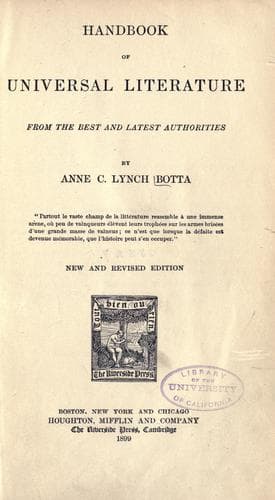
Handbook of Universal Literature, From the Best and Latest AuthoritiesBotta, Anne C. Lynch (Anne Charlotte Lynch)
History
Handbook of Universal Literature, From the Best and Latest Authorities
Botta, Anne C. Lynch (Anne Charlotte Lynch)
Literature -- History and criticism
Seneca, (12-69 A.D.), a native of Cordova in Spain, was the greatest
philosopher of this age. He early displayed great talent as a pleader, but
in the reign of Claudius he was banished to Corsica, where he solaced his
exile with the study of the Stoic philosophy; and though its severe
precepts exercised no moral influence on his conduct, he not only
professed himself a Stoic, but imagined that he was one. A few years
after, he was recalled by Agrippina, to become tutor to her son Nero. He
was too unscrupulous a man of the world to attempt the correction of the
vicious propensities of his pupil, or to instill into him high principles.
After the accession of Nero, he endeavored to arrest his depraved career,
but it was too late. Seneca had, by usury and legacy-hunting, amassed one
of those large fortunes of which so many instances are met with in Roman
history; feeling the dangers of wealth, he offered his property to Nero,
who refused it, but resolved to rid himself of his former tutor, and
easily found a pretext for his destruction. In adversity the character of
Seneca shone with brighter lustre. Though he had lived ill, he could die
well. He met the messengers of death without trembling. His noble wife,
Paulina, determined to die with him. The veins of both were opened at the
same time, but the little blood which remained in his emaciated frame
refused to flow. He suffered excruciating agony. A warm bath was tried,
but in vain; and a draught of poison was equally ineffectual. At last he
was suffocated by the vapor of a stove.
Seneca lived in a perilous atmosphere. He had not firmness to act up to
the high moral standard which he proposed to himself. He was avaricious,
but avarice was the great sin of his times. The education of one who was a
brute rather than a man was a task to which no one would have been equal;
he therefore retained the influence which he had not the uprightness to
command, by miserable and sinful expedients. He had great abilities, and
some of the noble qualities of the old Romans; and had he lived in the
days of the republic, he would have been a great man.
Public-domain text, read in full here on John Shaqi.
Reviews
Reviews
No reviews yet
Be the first to share your thoughts on this work.
Elsewhere in the archive
Join the Discussion
Join the discussion
Sign in to leave a comment or review.
Sign InorCreate an account