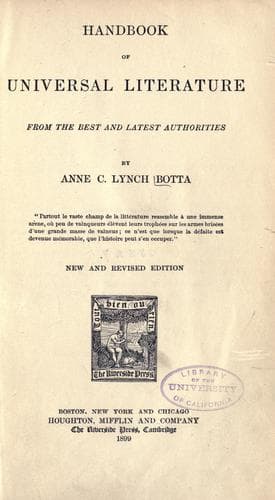
Handbook of Universal Literature, From the Best and Latest AuthoritiesBotta, Anne C. Lynch (Anne Charlotte Lynch)
History
Handbook of Universal Literature, From the Best and Latest Authorities
Botta, Anne C. Lynch (Anne Charlotte Lynch)
Literature -- History and criticism
Seneca was the author of twelve ethical treatises, the best of which are
entitled, "On Providence," "On Consolation," and "On the Perseverance of
Wise Men." He cared little for abstract speculation, and delighted to
inculcate precepts rather than to investigate principles. He was always a
favorite with Christian writers, and some of his sentiments are truly
Christian. There is even a tradition that he was acquainted with St. Paul.
He may unconsciously have imbibed some of the principles of Christianity.
The gospel had already made great and rapid strides over the civilized
world, and thoughtful minds may have been enlightened by some of the rays
of divine truth dispersed by the moral atmosphere, just as we are
benefited by the light of the sun, even when its disk is obscured by
clouds. His epistles, of which there are one hundred and twenty-four, are
moral essays, and are the most delightful of his works. They are evidently
written for the public eye; they are rich in varied thought, and their
reflections flow naturally, and without effort. They contain a free and
unconstrained picture of his mind, and we see in them how he despised
verbal subtleties, the external badges of a sect or creed, and insisted
that the great end of science is to learn how to live and how to die. The
style of Seneca is too elaborate to please. It is affected, often florid,
and bombastic; there is too much sparkle and glitter, too little repose
and simplicity.
Pliny the elder (A.D. 23-79) was born probably at Como, the family
residence. He was educated at Rome, where he practiced at the bar, and
filled different civil offices. He perished a martyr to the cause of
science, in the eruption of Vesuvius, which took place in the reign of
Titus, the first of which there is any record in history. The
circumstances of his death are described by his nephew, Pliny the younger,
in two letters to Tacitus. He was at Misenum, in command of the fleet,
when, observing the first indications of the eruption, and wishing to
investigate it more closely, he fitted out a light galley, and sailed
towards the villa of a friend at Stabiae. He found his friend in great
alarm, but Pliny remained tranquil and retired to rest. Meanwhile, broad
flames burst forth from the volcano, the blaze was reflected from the sky,
and the brightness was enhanced by the darkness of the night. Repeated
shocks of an earthquake made the houses rock to and fro, while in the air
the fall of half burnt pumice-stones menaced danger. He was awakened, and
he and his friend, with their attendants, tied cushions over their heads
to protect them from the falling stones, and walked out to see if they
might venture on the water. It was now day, but the darkness was denser
than the darkest night, the sea was a waste of stormy waters, and when at
last the flames and the sulphureous smell could no longer be endured,
Pliny fell dead, suffocated by the dense vapor.
Public-domain text, read in full here on John Shaqi.
Reviews
Reviews
No reviews yet
Be the first to share your thoughts on this work.
Elsewhere in the archive
Join the Discussion
Join the discussion
Sign in to leave a comment or review.
Sign InorCreate an account