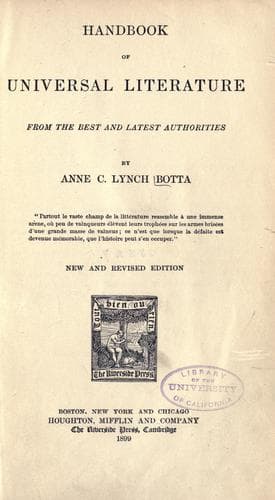
Handbook of Universal Literature, From the Best and Latest AuthoritiesBotta, Anne C. Lynch (Anne Charlotte Lynch)
History
Handbook of Universal Literature, From the Best and Latest Authorities
Botta, Anne C. Lynch (Anne Charlotte Lynch)
Literature -- History and criticism
10. ROMAN JURISPRUDENCE.--In the period which followed, from the death of
Augustus to the time of the Antonines, Roman civilians and legal writers
continued to be numerous, and as a professional body they seem to have
enjoyed high consideration until the close of the reign of Alexander
Severus, 385* A.D. After that time they were held in much less estimation,
as the science fell into the hands of freedmen and plebeians, who
practiced it as a sordid and pernicious trade. With the reign of
Constantine, the credit of the profession revived, and the youth of the
empire were stimulated to pursue the study of the law by the hope of being
ultimately rewarded by honorable and lucrative offices, the magistrates
being almost wholly taken from the class of lawyers. Two jurists of this
reign, Gregorianus and Hermogenianus, are particularly distinguished as
authors of codes which are known by their names, and which were recognized
as standard authorities in courts of justice. The "Code of Theodosius" was
a collection of laws reduced by that emperor, and promulgated in both
empires 438 A.D. It retained its authority in the western empire until its
final overthrow, 476 A.D., and even after this, though modified by the
institutions of the conquerors. In the eastern empire, it was only
superseded by the code of Justinian. This emperor undertook the task of
reducing to order and system the great confusion and perplexity in which
the whole subject of Roman jurisprudence was involved. For this purpose he
employed the most eminent lawyers, with the celebrated Tribonian at their
head, to whom he intrusted the work of forming and publishing a complete
collection of the preceding laws and edicts, and who devoted several years
of unwearied labor and research to this object. They first collected and
reduced the imperial constitutions from the time of Hadrian downwards,
which was promulgated as the "Justinian Code." Their next labor was to
reduce the writings of the jurisconsults of the preceding ages, especially
those who had lived under the empire, and whose works are said to have
amounted to two thousand volumes. This work was published 533 A.D., under
the title of "Pandects," or "Digest," the former title referring to their
completeness as comprehending the whole of Roman jurisprudence, and the
latter to their methodical arrangement. At the same time, a work prepared
by Tribonian was published by the order of the emperor, on the elements or
first principles of Roman law, entitled "Institutes," and another
collection consisting of constitutions and edicts, under the title of
"Novels," chiefly written in Greek, but known to the moderns by a Latin
translation. These four works, the Code, the Pandects, the Institutes, and
the Novels, constituted what is now called the Body of Roman Law.
Public-domain text, read in full here on John Shaqi.
Reviews
Reviews
No reviews yet
Be the first to share your thoughts on this work.
Elsewhere in the archive
Join the Discussion
Join the discussion
Sign in to leave a comment or review.
Sign InorCreate an account