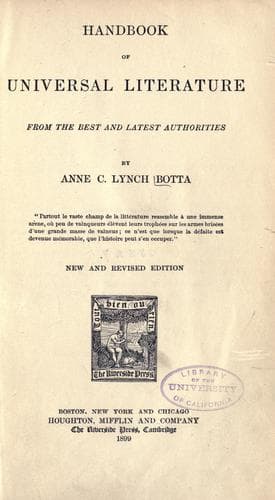
Handbook of Universal Literature, From the Best and Latest AuthoritiesBotta, Anne C. Lynch (Anne Charlotte Lynch)
History
Handbook of Universal Literature, From the Best and Latest Authorities
Botta, Anne C. Lynch (Anne Charlotte Lynch)
Literature -- History and criticism
The most eloquent orators and writers of this period were found among the
advocates of Christianity; and among the most celebrated of these Latin
fathers of the Christian church we may mention the following names.
Tertullian (160-285), in his apology for the Christians, gives much
information on the manners and conduct of the early Christians; his style
is concise and figurative, but harsh, unpolished, and obscure. St. Cyprian
(200-258), beheaded at Carthage for preaching the gospel contrary to the
orders of the government, wrote an explanation of the Lord's Prayer, which
affords a valuable illustration of the ecclesiastical history of the time.
Arnobius (fl. 300) refuted the objections of the heathen against
Christianity with spirit and learning, in his "Disputes with the
Gentiles," a work rich in materials for the understanding of Greek and
Roman mythology. Lactantius (d. 335), on account of his fine and eloquent
language, is frequently called the Christian Cicero; his "Divine
Institutes" are particularly celebrated. St. Ambrose (340-397) obtained
great honor by his conduct as Bishop of Milan, and his writings bear the
stamp of his high Christian character. St. Augustine (360-430) was one of
the most renowned of all the Latin fathers. Though others may have been
more learned or masters of a purer style, none more powerfully touched and
warmed the heart towards religion. His "City of God" is one of the great
monuments of human genius. St. Jerome (330-420) wrote many epistles full
of energy and affection, as well as of religious zeal. He made a Latin
version of the Old Testament, which was the foundation of the Vulgate, and
which gave a new impulse to the study of the Holy Scriptures. Leo the
Great (fl. 440) is the first pope whose writings have been preserved. They
consist of sermons and letters. His style is finished and rhetorical.
Public-domain text, read in full here on John Shaqi.
Reviews
Reviews
No reviews yet
Be the first to share your thoughts on this work.
Elsewhere in the archive
Join the Discussion
Join the discussion
Sign in to leave a comment or review.
Sign InorCreate an account