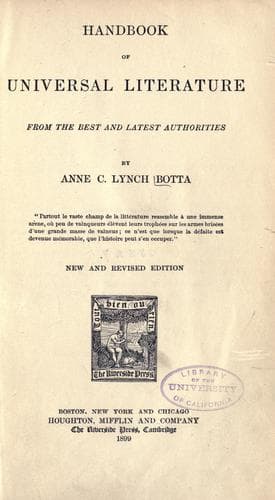
Handbook of Universal Literature, From the Best and Latest AuthoritiesBotta, Anne C. Lynch (Anne Charlotte Lynch)
History
Handbook of Universal Literature, From the Best and Latest Authorities
Botta, Anne C. Lynch (Anne Charlotte Lynch)
Literature -- History and criticism
At the memorable epoch of the overthrow of the Roman dominion in the West
(476 A.D.), the seats of the Teutonic race extended from the banks of the
Rhine and the Danube to the rock-bound coasts of Norway. The victorious
invaders who occupied the southern provinces of Europe speedily lost their
own forms of speech, which were broken down, together with those of the
vanquished, into a jargon unfit for composition. But in Germany and
Scandinavia, where the old language retained its purity, song continued to
flourish. There, from the most distant eras described by Tacitus and other
Latin writers, the favorite attendants of kings and chiefs were those
celebrated bards who preserved in their traditionary strains the memory of
great events, the praises of the gods, the glory of warriors, and the laws
and customs of their countrymen. Intrusted, like the Grecian heroic
minstrelsy, to oral recitation, it was not until the propitious reign of
Charlemagne that these verses were collected. But, through the bigotry of
his successor or the ravages of time, not a fragment of this collection
remains. We are enabled, however, to form an idea of the general tone and
tenor of this early Teutonic poetry from other interesting remains. The
"Nibelungen-Lied" (_Lay of the Nibelungen_) and "Heldenbuch" (_Book of
Heroes_) may be regarded as the Homeric poems of Germany. After an
examination of their monuments, the ability of the ancient bards, the
honor in which they were held, and the enthusiasm which they produced,
will not be surprising.
Equally distinguished were the Scalds of Scandinavia. Ever in the train of
princes and gallant adventurers, they chanted their rhymeless verse for
the encouragement and solace of heroes. Their oldest songs, or sagas, are
mostly of a historical import. In the Icelandic Edda, however, the richest
monument of this species of composition, the theological element of their
poetry is shadowed out in the most picturesque and fanciful legends.
Such was the intellectual state of Europe down to the age of Charlemagne.
While in the once famous seats of arts and arms scarcely a ray of native
genius or courage was visible, the light of human intellect still burned
in lands whose barbarism had furnished matter for the sarcasm of classical
writers.
Charlemagne encouraged learning, established schools, and filled his court
with men of letters; while in England, the illustrious Alfred, himself a
scholar and an author, improved and enriched the Anglo-Saxon dialect, and
exerted the most beneficial influence on his contemporaries.
Public-domain text, read in full here on John Shaqi.
Reviews
Reviews
No reviews yet
Be the first to share your thoughts on this work.
Elsewhere in the archive
Join the Discussion
Join the discussion
Sign in to leave a comment or review.
Sign InorCreate an account