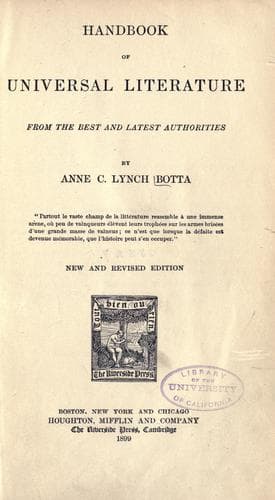
Handbook of Universal Literature, From the Best and Latest AuthoritiesBotta, Anne C. Lynch (Anne Charlotte Lynch)
History
Handbook of Universal Literature, From the Best and Latest Authorities
Botta, Anne C. Lynch (Anne Charlotte Lynch)
Literature -- History and criticism
The confusion and debasement of language in the south of Europe has
already been alluded to. But the force and activity of mind, that formed
an essential characteristic of the conquering race, were destined
ultimately to evolve regularity and harmony out of the concussion of
discordant elements. The Latin and Teutonic tongues were blended together,
and hence proceeded all the chief dialects of modern Europe. Over the
south, from Portugal to Italy, the Latin element prevailed; but even where
the Teutonic was the chief ingredient, as in the English and German, there
has also been a large infusion of the Latin. To these two languages, and
to the Provençal, French, Italian, Spanish, and Portuguese, called, from
their Roman origin, the Romance or Romanic languages, all that is
prominent and precious in modern letters belongs. But it is not until the
eleventh century that their progress becomes identified with the history
of literature. Up to this period there had been little repose, freedom, or
peaceful enjoyment of property. The independence and industry of the
middle classes were almost unknown, and the chieftain, the vassal, and the
slave were the characters which stood out in the highest relief.
Throughout the whole of the eleventh century, the social chaos seemed
resolving itself into some approach to order and tranquillity. The gradual
abolition of personal servitude, hardly accomplished in three successive
centuries, now began. A third estate arose. The rights of cities, and the
corporation-spirit, the result of the necessity that drove men to combine
for mutual defense, led to intercourse among them and to consequent
improvement in language. Chivalry, also, served to mitigate the
oppressions of the nobles, and to soften and refine their manners. From
the date of the first crusade (1093 A.D.) down to the close of the twelfth
century, was the golden age of chivalry. The principal thrones of Europe
were occupied by her foremost knights. The East formed a point of union
for the ardent and adventurous of different countries, whose courteous
rivalry stimulated the growth of generous sentiments and the passion for
brave deeds. The genius of Europe was roused by the passage of thousands
of her sons through Greece into Asia and Egypt, amidst the ancient seats
of art, science, and refinement; and the minds of men received a fresh and
powerful impulse. It was during the eleventh century that the brilliancy
of the Arabian literature reached its culminating point, and, through the
intercourse of the Troubadours with the Moors of the peninsula, and of the
Crusaders with the Arabs in the East, began to influence the progress of
letters in Europe.
Public-domain text, read in full here on John Shaqi.
Reviews
Reviews
No reviews yet
Be the first to share your thoughts on this work.
Elsewhere in the archive
Join the Discussion
Join the discussion
Sign in to leave a comment or review.
Sign InorCreate an account