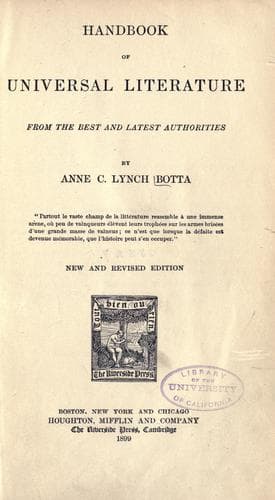
Handbook of Universal Literature, From the Best and Latest AuthoritiesBotta, Anne C. Lynch (Anne Charlotte Lynch)
History
Handbook of Universal Literature, From the Best and Latest Authorities
Botta, Anne C. Lynch (Anne Charlotte Lynch)
Literature -- History and criticism
Mohammed (569-632 A.D.) did not pretend to introduce a new religion; his
professed object was merely to restore the primitive and only true faith,
such as it had been in the days of the patriarchs; the fundamental idea of
which was the unity of God. He made the revelations of the Old and New
Testaments the basis of his preaching. He maintained the authority of the
books of Moses, admitted the divine mission of Jesus, and he enrolled
himself in the catalogue of inspired teachers. This doctrine was
proclaimed in the memorable words, which for so many centuries constituted
the war-cry of the Saracens,--_There is no God but God, and Mohammed is
his prophet_. Mohammed preached no dogmas substantially new, but he
adorned, amplified, and adapted to the ideas, prejudices, and inclinations
of the Orientals, doctrines which were as old as the race. He enjoined the
ablutions suited to the manners and necessities of hot climates. He
ordained five daily prayers, that man might learn habitually to elevate
his thoughts above the outward world. He instituted the festival of the
Ramadan, and the pilgrimage to Mecca, and commanded that every man should
bestow in alms the hundredth part of his possessions; observances which,
for the most part, already existed in the established customs of the
country.
The Koran (Reading), the sacred book of the Mohammedans, is, according to
their belief, the revelation of God to their prophet Mohammed. It contains
not only their religious belief, but their civil, military, and political
code. It is divided into 114 chapters, and 1,666 verses. It is written in
rhythmical prose, and its materials are borrowed from the Jewish and
Christian scriptures, the legends of the Talmud, and the traditions and
fables of the Arabian and Persian mythologies. Confusion of ideas,
obscurity, and contradictions destroy the unity and even the interest of
this work. The chapters are preposterously distributed, not according to
their date or connection, but according to their length, beginning with
the longest, and ending with the shortest; and thus the work becomes often
the more unintelligible by its singular arrangement. But notwithstanding
this, there is scarcely a volume in the Arabic language which contains
passages breathing more sublime poetry, or more enchanting eloquence; and
the Koran is so far important in the history of Arabian letters, that when
the scattered leaves were collected by Abubeker, the successor of Mohammed
(635 A.D.) and afterwards revised, in the thirtieth year of the Hegira,
they fixed at once the classic language of the Arabs, and became their
standard in style as well as in religion.
Public-domain text, read in full here on John Shaqi.
Reviews
Reviews
No reviews yet
Be the first to share your thoughts on this work.
Elsewhere in the archive
Join the Discussion
Join the discussion
Sign in to leave a comment or review.
Sign InorCreate an account