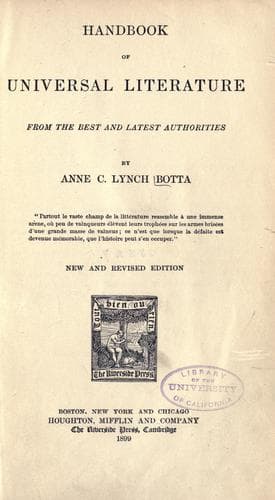
Handbook of Universal Literature, From the Best and Latest AuthoritiesBotta, Anne C. Lynch (Anne Charlotte Lynch)
History
Handbook of Universal Literature, From the Best and Latest Authorities
Botta, Anne C. Lynch (Anne Charlotte Lynch)
Literature -- History and criticism
2. THE ARABIAN LANGUAGE.--The Arabian language belongs to the Semitic
family; it has two principal dialects--the northern, which has, for
centuries, been the general tongue of the empire, and is best represented
in literature, and the southern, a branch of which is supposed to be the
mother of the Ethiopian language. The former, in degenerated dialects, is
still spoken in Arabia, in parts of western Asia, and throughout northern
Africa, and forms an important part of the Turkish, Persian, and other
Oriental languages. The Arabic is characterized by its guttural sounds, by
the richness and pliability of its vowels, by its dignity, volume of
sound, and vigor of accentuation and pronunciation. Like all Semitic
languages, it is written from right to left; the characters are of Syrian
origin, and were introduced into Arabia before the time of Mohammed. They
are of two kinds, the Cufic, which were first used, and the Neskhi, which
superseded them, and which continue in use at the present day. The Arabic
alphabet was, with a few modifications, early adopted by the Persians and
Turks.
3. ARABIAN MYTHOLOGY AND THE KORAN.--Before the time of Mohammed, the
Arabians were gross idolaters. They had some traditionary idea of the
unity and perfections of the Deity, but their creed embraced an immense
number of subordinate divinities, represented by images of men and women,
beasts and birds. The essential basis of their religion was Sabeism, or
star-worship. The number and beauty of the heavenly luminaries, and the
silent regularity of their motions, could not fail deeply to impress the
minds of this imaginative people, living in the open air, under the clear
and serene sky, and wandering among the deserts, oases, and picturesque
mountains of Arabia. They had seven celebrated temples dedicated to the
seven planets. Some tribes exclusively reverenced the moon; others the
dog-star. Some had received the religion of the Magi, or fire-worshipers,
while others had become converts to Judaism.
Ishmael is one of the most venerated progenitors of the nation; and it is
the common faith that Mecca, then an arid wilderness, was the spot where
his life was providentially saved, and where Hagar, his mother, was
buried. The well pointed out by the angel, they believe to be the famous
Zemzem, of which all pious Mohammedans drink to this day. To commemorate
the miraculous preservation of Ishmael, God commanded Abraham to build a
temple, and he erected and consecrated the Caaba, or sacred house, which
is still venerated in Mecca; and the black stone incased within its walls
is the same on which Abraham stood.
Public-domain text, read in full here on John Shaqi.
Reviews
Reviews
No reviews yet
Be the first to share your thoughts on this work.
Elsewhere in the archive
Join the Discussion
Join the discussion
Sign in to leave a comment or review.
Sign InorCreate an account