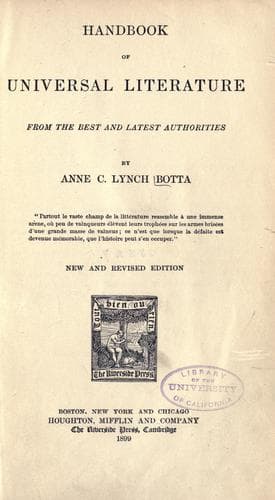
Handbook of Universal Literature, From the Best and Latest AuthoritiesBotta, Anne C. Lynch (Anne Charlotte Lynch)
History
Handbook of Universal Literature, From the Best and Latest Authorities
Botta, Anne C. Lynch (Anne Charlotte Lynch)
Literature -- History and criticism
The Hegira, or flight of Mohammed from Mecca to Medina, corresponds with
the year 622 of our era, and the supposed burning of the Alexandrian
library by Amrou, the general of the Caliph Omar, with the year 641. This
is the period of the deepest barbarism among the Saracens, and this event,
doubtful as it is, has left a melancholy proof of their contempt for
letters. A century had scarcely elapsed from the period to which this
barbarian outrage is referred, when the family of the Abassides, who
mounted the throne of the Caliphs in 750, introduced a passionate love of
art, of science, and of poetry. In the literature of Greece, nearly eight
centuries of progressive cultivation succeeding the Trojan war had
prepared the way for the age of Pericles. In that of Rome, the age of
Augustus was also in the eighth century after the foundation of the city.
In French literature, the age of Louis XIV. was twelve centuries
subsequent to Clovis, and eight after the development of the first
rudiments of the language. But, in the rapid progress of the Arabian
empire, the age of Al Mamoun, the Augustus of Bagdad, was not removed more
than one hundred and fifty years from the foundation of the monarchy. All
the literature of the Arabians bears the marks of this rapid development.
Ali, the fourth Caliph from Mohammed, was the first who extended any
protection to letters. His rival and successor, Moawyiah, the first of the
Ommyiades (661-680), assembled at his court all who were most
distinguished by scientific acquirements; he surrounded himself with
poets; and as he had subjected to his dominion many of the Grecian islands
and provinces, the sciences of Greece under him first began to obtain any
influence over the Arabians.
After the extinction of the dynasty of the Ommyiades, that of the
Abassides bestowed a still more powerful patronage on letters. The
celebrated Haroun al Raschid (786-809) acquired a glorious reputation by
the protection he afforded to letters. He never undertook a journey
without carrying with him at least a hundred men of science in his train,
and he never built a mosque without attaching to it a school.
Public-domain text, read in full here on John Shaqi.
Reviews
Reviews
No reviews yet
Be the first to share your thoughts on this work.
Elsewhere in the archive
Join the Discussion
Join the discussion
Sign in to leave a comment or review.
Sign InorCreate an account