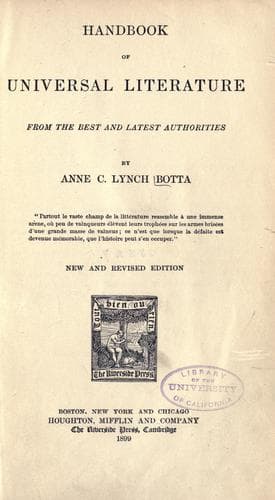
Handbook of Universal Literature, From the Best and Latest AuthoritiesBotta, Anne C. Lynch (Anne Charlotte Lynch)
History
Handbook of Universal Literature, From the Best and Latest Authorities
Botta, Anne C. Lynch (Anne Charlotte Lynch)
Literature -- History and criticism
But the true protector and father of Arabic literature was Al Mamoun, the
son of Haroun al Raschid (813-833), who rendered Bagdad the centre of
literature. He invited to his court from every part of the world all the
learned men with whose existence he was acquainted, and he retained them
by rewards, honors, and distinctions of every kind. He exacted, as the
most precious tribute from the conquered provinces, all the important
books and literary relics that could be discovered. Hundreds of camels
might be seen entering Bagdad, loaded with nothing but manuscripts and
papers, and those most proper for instruction were translated into Arabic.
Instructors, translators, and commentators formed the court of Al Mamoun,
which appeared to be rather a learned academy, than the seat of government
in a warlike empire. The Caliph himself was much attached to the study of
mathematics, which he pursued with brilliant success. He conceived the
grand design of measuring the earth, which was accomplished by his
mathematicians, at his own expense. Not less generous than enlightened, Al
Mamoun, when he pardoned one of his relatives who had revolted against
him, exclaimed, "If it were known what pleasure I experience in granting
pardon, all who have offended against me would come and confess their
crimes."
The progress of the Arabians in science was proportioned to the zeal of
the sovereign. In every town of the empire schools, colleges, and
academies were established. Bagdad was the capital of letters as well as
of the Caliphs, but Bassora and Cufa almost equaled that city in
reputation, and in the number of celebrated poems and treatises that they
produced. Balkh, Ispahan, and Samarcand were equally the homes of science.
Cairo contained a great number of colleges; in the towns of Fez and
Morocco the most magnificent buildings were appropriated to the purposes
of instruction, and in their rich libraries were preserved those precious
volumes which had been lost in other places.
Public-domain text, read in full here on John Shaqi.
Reviews
Reviews
No reviews yet
Be the first to share your thoughts on this work.
Elsewhere in the archive
Join the Discussion
Join the discussion
Sign in to leave a comment or review.
Sign InorCreate an account