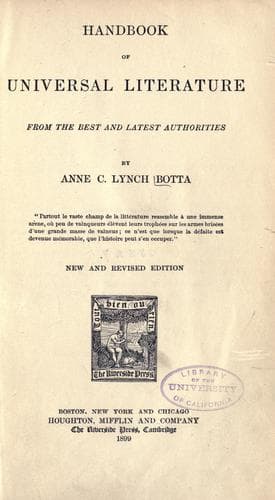
Handbook of Universal Literature, From the Best and Latest AuthoritiesBotta, Anne C. Lynch (Anne Charlotte Lynch)
History
Handbook of Universal Literature, From the Best and Latest Authorities
Botta, Anne C. Lynch (Anne Charlotte Lynch)
Literature -- History and criticism
The natural sciences were cultivated by them with great ardor, and many
naturalists among them merit the gratitude of posterity. Botany and
chemistry, of which they were in some sort the inventors, gave them a
better acquaintance with nature than the Greeks or Romans ever possessed,
and the latter science was applied by them to all the necessary arts of
life. Above all, agriculture was studied by them with a perfect knowledge
of the climate, soil, and growth of plants. From the eighth to the
eleventh century, they established medical schools in the principal cities
of their dominions, and published valuable works on medical science. They
introduced more simple principles into mathematics, and extended the use
and application of that science. They added to arithmetic the decimal
system, and the Arabic numerals, which, however, are of Hindu origin; they
simplified the trigonometry of the Greeks, and gave algebra more useful
and general applications. Bagdad and Cordova had celebrated schools of
astronomy, and observatories, and their astronomers made important
discoveries; a great number of scientific words are evidently Arabic, such
as algebra, alcohol, zenith, nadir, etc., and many of the inventions,
which at the present day add to the comforts of life, are due to the
Arabians. Paper, now so necessary to the progress of intellect, was
brought by them from Asia. In China, from all antiquity, it had been
manufactured from silk, but about the year 30 of the Hegira (649 A.D.) the
manufacture of it was introduced at Samarcand, and when that city was
conquered by the Arabians, they first employed cotton in the place of
silk, and the invention spread with rapidity throughout their dominions.
The Spaniards, in fabricating paper, substituted flax for cotton, which
was more scarce and dear; but it was not till the end of the thirteenth
century that paper mills were established in the Christian states of
Spain, from whence the invention passed, in the fourteenth century only,
to Treviso and Padua. Tournaments were first instituted among the
Arabians, from whom they were introduced into Italy and France. Gunpowder,
the discovery of which is generally attributed to a German chemist, was
known to the Arabians at least a century before any trace of it appeared
in European history. The compass, also, the invention of which has been
given alternately to the Italians and French in the thirteenth century,
was known to the Arabians in the eleventh. The number of Arabic
inventions, of which we enjoy the benefit without suspecting it, is
prodigious.
Public-domain text, read in full here on John Shaqi.
Reviews
Reviews
No reviews yet
Be the first to share your thoughts on this work.
Elsewhere in the archive
Join the Discussion
Join the discussion
Sign in to leave a comment or review.
Sign InorCreate an account