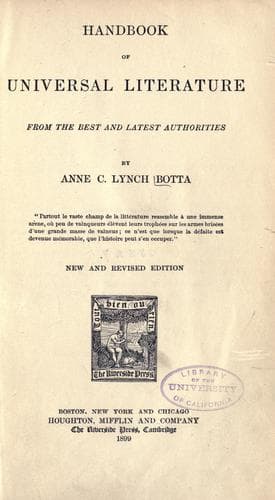
Handbook of Universal Literature, From the Best and Latest AuthoritiesBotta, Anne C. Lynch (Anne Charlotte Lynch)
History
Handbook of Universal Literature, From the Best and Latest Authorities
Botta, Anne C. Lynch (Anne Charlotte Lynch)
Literature -- History and criticism
8. HISTORY AND SCIENCE.--As early as the eighth century A.D., history
became an important department in Arabian literature. At later periods,
historians who wrote on all subjects were numerous. Several authors wrote
universal history from the beginning of the world to their own time; every
state, province, and city possessed its individual chronicle, Many, in
imitation of Plutarch, wrote the lives of distinguished men; and there was
such a passion for every species of composition, and such a desire to
leave no subject untouched, that there was a serious history written of
celebrated horses, and another of camels that had risen to distinction.
They possessed historical dictionaries, and made use of all those
inventions which curtail labor and dispense with the necessity of
research. Every art and science had its history, and of these this nation
possessed a more complete collection than any other, either ancient or
modern. The style of the Arabian historians is simple and unadorned.
Philosophy was passionately cultivated by the Arabians, and upon it was
founded the fame of many ingenious and sagacious men, whose names are
still revered in Europe. Among them were Averrhoes of Cordova (d. 1198),
the great commentator on the works of Aristotle, and Avicenna (d. 1037), a
profound philosopher as well as a celebrated writer on medicine. Arabian
philosophy penetrated rapidly into the West, and had greater influence on
the schools of Europe than any branch of Arabic literature; and yet it was
the one in which the progress was, in fact, the least real. The Arabians,
more ingenious than profound, attached themselves rather to the subtleties
than to the connection of ideas; their object was more to dazzle than to
instruct, and they exhausted their imaginations in search of mysteries.
Aristotle was worshiped by them, as a sort of divinity. In their opinion
all philosophy was to be found in his writings, and they explained every
metaphysical question according to the scholastic standard.
The interpretation of the Koran formed another important part of their
speculative studies, and their literature abounds with exegetic works on
their sacred book, as well as with commentaries on Mohammedan law. The
learned Arabians did not confine themselves to the studies which they
could only prosecute in their closets; they undertook, for the advancement
of science, the most perilous journeys, and we owe to Aboul Feda (1273-
1331) and other Arabian travelers the best works on geography written in
the Middle Ages.
Public-domain text, read in full here on John Shaqi.
Reviews
Reviews
No reviews yet
Be the first to share your thoughts on this work.
Elsewhere in the archive
Join the Discussion
Join the discussion
Sign in to leave a comment or review.
Sign InorCreate an account