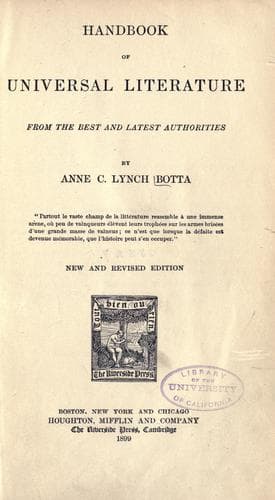
Handbook of Universal Literature, From the Best and Latest AuthoritiesBotta, Anne C. Lynch (Anne Charlotte Lynch)
History
Handbook of Universal Literature, From the Best and Latest Authorities
Botta, Anne C. Lynch (Anne Charlotte Lynch)
Literature -- History and criticism
1. ITALIAN LITERATURE AND ITS DIVISIONS.--The fall of the Western Empire,
the invasions of the northern tribes, and the subsequent wars and
calamities, did not entirely extinguish the fire of genius in Italy. As we
have seen, the Crusades had opened the East and revealed to Europe its
literary and artistic treasures; the Arabs had established a celebrated
school of medicine in Salerno, and had made known the ancient classics; a
school of jurisprudence was opened in Bologna, where Roman law was
expounded by eminent lecturers; and the spirit of chivalry, while it
softened and refined human character, awoke the desire of distinction in
arms and poetry. The origin of the Italian republics, giving scope to
individual agency, marked another era in civilization; while the
appearance of the Italian language quickened the national mind and led to
a new literature. The spirit of freedom, awakened as early as the eleventh
century, received new life in the twelfth, when the Lombard cities,
becoming independent, formed a powerful league against Frederick
Barbarossa. The instinct of self-defense thus developed increased the
necessity of education. In the thirteenth and fourteenth centuries,
Italian literature acquired its national character and rose to its highest
splendor, through the writings of Dante, Petrarch, and Boccaccio, whose
influence has been more or less felt in succeeding centuries.
The literary history of Italy may be divided into three periods, each of
which presents two distinct phases, one of progress and one of decline.
The first period, extending from 1100 to 1475, embraces the origin of the
literature, its development through the works of Dante, Petrarch, and
Boccaccio, in the thirteenth and fourteenth centuries, and its first
decline in the fifteenth, when it was supplanted by the absorbing study of
the Greek and Latin classics.
The second period, commencing 1475, embraces the age of Lorenzo de' Medici
and Leo X., when literature began to revive; the age of Ariosto, Tasso,
Machiavelli, and Galileo, when it reached its meridian splendor; its
subsequent decline, through the school of Marini; and its last revival
towards the close of the seventeenth century.
The third period, extending from the close of the seventeenth century to
the present time, includes the development of Italian literature, its
decline under French influence, and its subsequent national tendency,
through the writings of Metastasio, Goldoni, Alfieri, Parini, Monti,
Manzoni, and Leopardi.
Public-domain text, read in full here on John Shaqi.
Reviews
Reviews
No reviews yet
Be the first to share your thoughts on this work.
Elsewhere in the archive
Join the Discussion
Join the discussion
Sign in to leave a comment or review.
Sign InorCreate an account