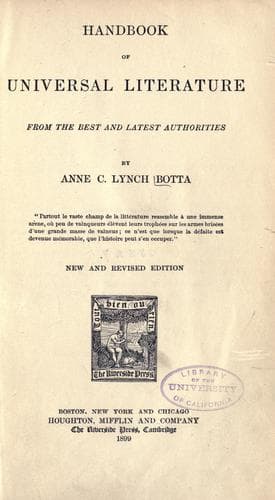
Handbook of Universal Literature, From the Best and Latest AuthoritiesBotta, Anne C. Lynch (Anne Charlotte Lynch)
History
Handbook of Universal Literature, From the Best and Latest Authorities
Botta, Anne C. Lynch (Anne Charlotte Lynch)
Literature -- History and criticism
2. THE DIALECTS.--The dialects of the ancient tribes inhabiting the
peninsula early came in contact with the rustic Latin, and were moulded
into new tongues, which, at a later period, were again modified by the
influence of the barbarians who successively invaded the country. These
tongues, elaborated by the action of centuries, are still in use,
especially with the lower classes, and many of them have a literature of
their own, with grammars and dictionaries. The more important of these
dialects are divided into three groups: 1st. The Northern, including the
Ligurian, Piedmontese, Lombard, Venetian, and Emilian. 2d. The Central,
containing the Tuscan, Umbrian, the dialects of the Marches and of the
Roman Provinces. 3d. The Southern, embracing those of the Neapolitan
provinces and of Sicily. Each is distinguished from the other and from the
true Italian, although they all rest on a common basis, the rustic Latin,
the plebeian tongue of the Romans, as distinct from the official and
literary tongue.
3. THE ITALIAN LANGUAGE.--The Tuscan or Florentine dialect, which early
became the literary language of Italy, was the result of the natural
development of the popular Latin and a native dialect probably akin to the
rustic Roman idiom. Tuscany suffering comparatively little from foreign
invasion, the language lost none of its purity, and remained free from
heterogeneous elements. The great writers, Dante, Petrarch, and Boccaccio,
who appeared so early, promoted its perfection, secured its prevailing
influence, and gave it a national character. Hence, in the literature
there is no old Italian as distinct from the modern; the language of Dante
continues to be that of modern writers, and becomes more perfect the more
it approaches the standard fixed by the great masters of the fourteenth
century. Of this language it may he said that for flexibility,
copiousness, freedom of construction, and harmony and beauty of sound, it
is the most perfect of all the idioms of the Neo-Latin or Romanic tongues.
PERIOD FIRST.
FROM THE ORIGIN OF ITALIAN LITERATURE TO ITS FIRST DECLINE (1100-1475).
Public-domain text, read in full here on John Shaqi.
Reviews
Reviews
No reviews yet
Be the first to share your thoughts on this work.
Elsewhere in the archive
Join the Discussion
Join the discussion
Sign in to leave a comment or review.
Sign InorCreate an account