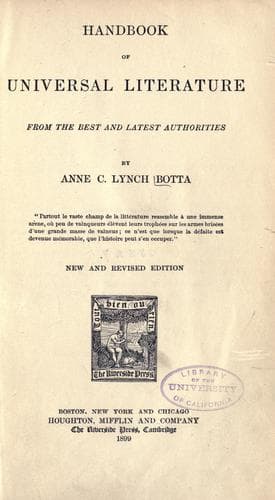
Handbook of Universal Literature, From the Best and Latest AuthoritiesBotta, Anne C. Lynch (Anne Charlotte Lynch)
History
Handbook of Universal Literature, From the Best and Latest Authorities
Botta, Anne C. Lynch (Anne Charlotte Lynch)
Literature -- History and criticism
Thus years passed away. Laura became the
mother of a numerous family, and time and care made havoc of her youthful
beauty. Meanwhile, the sonnets of Petrarch had spread her fame throughout
France and Italy, and attracted many to the court of Avignon, who were
surprised and disappointed at the sight of her whom they had believed to
be the loveliest of mortals. In 1347, during the absence of the poet from
Avignon, Laura fell a victim to the plague, just twenty-one years from the
day that Petrarch first met her. Now all his love was deepened and
consecrated, and the effusions of his poetic genius became more
melancholy, more passionate, and more beautiful than ever. He declined the
offices and honors that his countrymen offered him, and passed his life in
retirement. He was found one morning by his attendants dead in his
library, his head resting on a book.
The celebrity of Petrarch at the present day depends chiefly on his
lyrical poems, which served as models to all the distinguished poets of
southern Europe. They are restricted to two forms: the sonnet, borrowed
from the Sicilians, and the canzone, from the Provençals. The subject of
almost all these poems is the same--the hopeless affection of the poet for
the high-minded Laura. This love was a kind of religious and enthusiastic
passion, such as mystics imagine they feel towards the Deity, or such as
Plato believes to be the bond of union between elevated minds. There is no
poet in any language more perfectly pure than Petrarch--more completely
above all reproach of laxity or immorality. This merit, which is equally
due to the poet and to his Laura, is the more remarkable, considering the
models which he followed and the court at which Laura lived. The labor of
Petrarch in polishing his poems did much towards perfecting the language,
which through him became more elegant and more melodious. He introduced
into the lyric poetry of Italy the pathos and the touching sweetness of
Ovid and Tibullus, as well as the simplicity of Anacreon.
Petrarch attached little value to his Italian poems; it was on his Latin
works that he founded his hopes of renown. But his highest title to
immortal fame is his prodigious labor to promote the study of ancient
authors. Wherever he traveled, he sought with the utmost avidity for
classic manuscripts, and it is difficult to estimate the effect produced
by his enthusiasm. He corresponded with all the eminent literati of his
day, and inspired them with his own tastes. Now for the first time there
appeared a kind of literary republic in Europe united by the magic bond of
Petrarch's influence, and he was better known and exercised a more
extensive and powerful influence than many of the sovereigns of the day.
He treated with various princes rather in the character of an arbitrator
than an ambassador, and he not only directed the tastes of his own age,
but he determined those of succeeding generations.
Public-domain text, read in full here on John Shaqi.
Reviews
Reviews
No reviews yet
Be the first to share your thoughts on this work.
Elsewhere in the archive
Join the Discussion
Join the discussion
Sign in to leave a comment or review.
Sign InorCreate an account