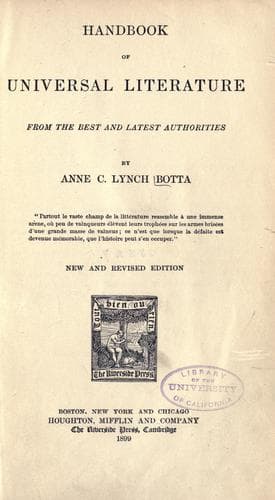
Handbook of Universal Literature, From the Best and Latest AuthoritiesBotta, Anne C. Lynch (Anne Charlotte Lynch)
History
Handbook of Universal Literature, From the Best and Latest Authorities
Botta, Anne C. Lynch (Anne Charlotte Lynch)
Literature -- History and criticism
The personal interest that he brings to bear on the historical
representation of the three worlds is that which most interests and stirs
us. The Divine Comedy is not only the most lifelike drama of the thoughts
and feelings that moved men at that time, but it is also the most
spontaneous and clear reflection of the individual feelings of the poet,
who remakes history after his own passions, and who is the real chastiser
of the sins and rewarder of the virtues. He defined the destiny of Italian
literature in the Middle Ages, and began the great era of the Renaissance.
4. PETRARCH.--Petrarch (1304-1374) belonged to a respected Florentine
family. His father was the personal friend of Dante, and a partaker of the
same exile. While at Avignon, then the seat of the papal court, on one
occasion he made an excursion to the fountain of Vaucluse, taking with him
his son, the future poet, then in the tenth year of his age. The wild and
solitary aspect of the place inspired the boy with an enthusiasm beyond
his years, leaving an impression which was never afterwards effaced, and
which affected his future life and writings. As Petrarch grew up, unlike
the haughty, taciturn, and sarcastic Dante, he seems to have made friends
wherever he went. With splendid talents, engaging manners, a handsome
person, and an affectionate and generous disposition, he became the
darling of his age, a man whom princes delighted to honor. At the age of
twenty-three, he first met Laura de Sade in a church at Avignon. She was
only twenty years of age, and had been for three years the wife of a
patrician of that city. Laura was not more distinguished for her beauty
and fortune than for the unsullied purity of her manners in a licentious
court, where she was one of the chief ornaments. The sight of her beauty
inspired the young poet with an affection which was as pure and virtuous
as it was tender and passionate. He poured forth in song the fervor of his
love and the bitterness of his grief. Upwards of three hundred sonnets,
written at various times, commemorate all the little circumstances of this
attachment, and describe the favors which, during an acquaintance of
fifteen or twenty years, never exceeded a kind word, a look less severe
than usual, or a passing expression of regret at parting. He was not
permitted to visit at Laura's house; he had no opportunity of seeing her
except at mass, at the brilliant levees of the pope, or in private
assemblies of beauty and fashion: but she forever remained the dominant
object of his existence. He purchased a house at Vaucluse, and there, shut
in by lofty and craggy heights, the river Sorgue traversing the valley on
one side, amidst hills clothed with umbrageous trees, cheered only by the
song of birds, the poet passed his lonely days. Again and again he made
tours through Italy, Spain, and Flanders, during one of which he was
crowned with the poet's laurel at Rome, but he always returned to
Vaucluse, to Avignon, to Laura.
Public-domain text, read in full here on John Shaqi.
Reviews
Reviews
No reviews yet
Be the first to share your thoughts on this work.
Elsewhere in the archive
Join the Discussion
Join the discussion
Sign in to leave a comment or review.
Sign InorCreate an account