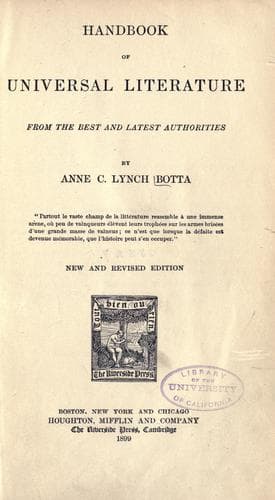
Handbook of Universal Literature, From the Best and Latest AuthoritiesBotta, Anne C. Lynch (Anne Charlotte Lynch)
History
Handbook of Universal Literature, From the Best and Latest Authorities
Botta, Anne C. Lynch (Anne Charlotte Lynch)
Literature -- History and criticism
The groundwork of the Decameron has been traced to an old Hindu romance,
which, after passing through all the languages of the East, was translated
into Latin as early as the twelfth century; the originals of several of
these tales have been found in the ancient French _Fabliaux_, while others
are believed to have been borrowed from popular recitation or from real
occurrences. But if Boccaccio cannot boast of being the inventor of all,
or even any of these tales, he is still the father of this class of modern
Italian literature, since he was the first to transplant into the world of
letters what had hitherto been only the subject of social mirth. These
tales have in their turn been repeated anew in almost every language of
Europe, and have afforded reputations to numerous imitators. One of the
most beautiful and unexceptionable tales in the Decameron is that of
"Griselda," the last in the collection. It is to be regretted that the
author did not prescribe to himself the same purity in his images that he
did in his phraseology. Many of these tales are not only immoral but
grossly indecent, though but too faithful a representation of the manners
of the age in which they were written. The Decameron was published towards
the middle of the fourteenth century; and, from the first invention of
printing, it was freely circulated in Italy, until the Council of Trent
proscribed it in the middle of the sixteenth century. It was, however,
again published in 1570, purified and abridged.
Boccaccio is the author of two romances, one called "Fiammetta," the other
the "Filocopo;" the former distinguished for the fervor of its expression,
the latter for the variety of its adventures and incidents. He wrote also
two romantic poems, in which he first introduced the _ottava rima_, or the
stanza composed of six lines, which rhyme interchangeably with each other,
and are followed by a couplet. In these he strove to revive ancient
mythology, and to identify it with modern literature. His Latin
compositions are voluminous, and materially contributed to the advancement
of letters.
While Boccaccio labored so successfully to reduce the language to elegant
and harmonious forms, he strove like Petrarch to excite his contemporaries
to the study of the ancient classics. He induced the senate of Florence to
establish a professorship of Greek, entered his name among the first of
the students, and procured manuscripts at his own expense. Thus Hellenic
literature was introduced into Tuscany, and thence into the rest of
Europe.
Public-domain text, read in full here on John Shaqi.
Reviews
Reviews
No reviews yet
Be the first to share your thoughts on this work.
Elsewhere in the archive
Join the Discussion
Join the discussion
Sign in to leave a comment or review.
Sign InorCreate an account