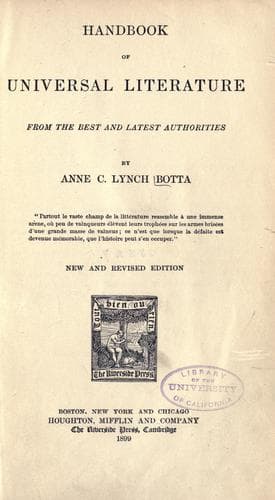
Handbook of Universal Literature, From the Best and Latest AuthoritiesBotta, Anne C. Lynch (Anne Charlotte Lynch)
History
Handbook of Universal Literature, From the Best and Latest Authorities
Botta, Anne C. Lynch (Anne Charlotte Lynch)
Literature -- History and criticism
Boccaccio, late in life, assumed the ecclesiastical habit, and entered on
the study of theology. When the Florentines founded a professorship for
the reading and exposition of the Divine Comedy, Boccaccio was made the
first incumbent. The result of his labors was a life of Dante, and a
commentary on the first seventeen cantos of the Inferno. With the death of
Petrarch, who had been his most intimate friend, his last tie to earth was
loosed; he died at Certaldo a few months later, in the sixty-third year of
his age. His dwelling is still to be seen, situated on a hill, and looking
down on the fertile and beautiful valley watered by the river Elsa.
Of the other prose writers of the fourteenth century the most remarkable
are the three Florentine historians named Villani, the eldest of whom
(1310-1348) wrote a history of Florence, which was continued afterwards by
his brother and by his nephew; a work highly esteemed for its historical
interest, and for its purity of language and style; and Franco Sacchetti
(1335-1400), who approaches nearest to Boccaccio. His "Novels and Tales"
are valuable for the purity and eloquence of their style, and for the
picture they afford of the manners of his age.
Among the ascetic writers of this age St. Catherine of Siena occupies an
important place, as one who aided in preparing the way for the great
religious movement of the sixteenth century. The writings of this
extraordinary woman, who strove to bring back the Church of Rome to
evangelical virtue, are the strongest, clearest, most exalted religious
utterance that made itself heard in Italy in the fourteenth century.
6. THE FIRST DECLINE OF ITALIAN LITERATURE.--The passionate study of the
ancients, of which Petrarch and Boccaccio had given an example, suspended
the progress of Italian literature in the latter part of the fourteenth
century, and through almost all the fifteenth. The attention of the
literary men of this time was wholly engrossed by the study of the dead
languages, and of manners, customs, and religious systems equally extinct.
They present to our observation boundless erudition, a just spirit of
criticism, and nice sensibility to the beauties and defects of the great
authors of antiquity; but we look in vain for that true eloquence which is
more the fruit of an intercourse with the world than of a knowledge of
books. They were still more unsuccessful in poetry, in which their
attempts, all in Latin, are few in number, and their verses harsh and
heavy, without originality or vigor. It was not until the period when
Italian poetry began to be again cultivated, that Latin verse acquired any
of the characteristics of genuine inspiration.
Public-domain text, read in full here on John Shaqi.
Reviews
Reviews
No reviews yet
Be the first to share your thoughts on this work.
Elsewhere in the archive
Join the Discussion
Join the discussion
Sign in to leave a comment or review.
Sign InorCreate an account