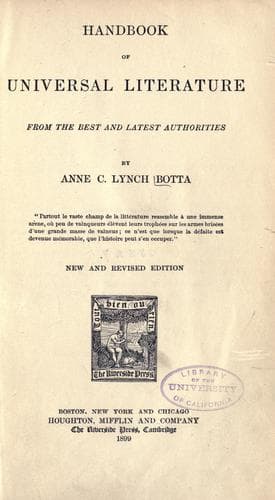
Handbook of Universal Literature, From the Best and Latest AuthoritiesBotta, Anne C. Lynch (Anne Charlotte Lynch)
History
Handbook of Universal Literature, From the Best and Latest Authorities
Botta, Anne C. Lynch (Anne Charlotte Lynch)
Literature -- History and criticism
Guicciardini (1483-1541), the friend of Machiavelli, is considered the
greatest historian of this age. He attached himself to the service of Leo
X., and was raised to high offices and honors by him and the two
succeeding popes. On the expulsion of the Medici from Florence, the
republican party having obtained the ascendency, he was obliged to fly
from the city. From this time he manifested an utter abhorrence of all
popular institutions, and threw himself heart and soul into the interests
of the Medici. He displayed his zeal at the expense of the lives and
liberties of the most virtuous among his fellow-citizens. Having aided in
the elevation of Cosmo, afterwards Grand Duke of Tuscany, and being
requited with ingratitude and neglect, he retired in disgust from public
life, and devoted himself wholly to the completion of his history of
Italy. This work, which is a monument of his genius and industry,
commences with the coming of Charles VIII. to Italy, and concludes with
the year 1534, embracing one of the most important periods of Italian
history. His powerfully-drawn pictures exhibit the men and the times so
vividly, that they seem to pass before our eyes. His delineations of
character, his masterly views of the course of events, the conduct of
leaders, and the changes of war, claim our highest admiration. His
language is pure and his style elegant, though sometimes too Latinized;
his letters are considered as a most valuable contribution to the history
of his times.
Numberless historians, of more or less merit, stimulated by the renown of
Machiavelli and Guicciardini, composed annals of the states to which they
belonged, while others undertook to write the histories of foreign
nations. Nardi (1496-1556), one of the most ardent and pure patriots of
his age, takes the first place. He wrote the history of the Florentine
Revolution of 1527, a work which, though defective in style, is
distinguished for its truthfulness. The histories of Florence by Adriani,
Varchi, and Segni (1499-1559), are considered the best works of their
kind, for elegance of style and for interest of the narrative. Almost all
the other cities of Italy had their historians, but the palm must be
awarded to the Florentine writers, not only on account of their number,
but for the elegance and purity of their style, for their impartiality and
the sagacity of their research into matters of fact. Among the writers of
the second class may be mentioned Davanzati (1519), the translator of
Tacitus, who wrote, in the Florentine dialect, a history of the schism of
England; Giambullari (1495-1564), who wrote a history of Europe;
D'Anghiera (fl. 1536), who, after having examined the papers of
Christopher Columbus, and the official reports transmitted from America to
Spain, compiled an interesting work on "Ocean Navigation and the New
World." His style is incorrect; but this is compensated for by the
fidelity of his narration. Several of the German States, France, the
Public-domain text, read in full here on John Shaqi.
Reviews
Reviews
No reviews yet
Be the first to share your thoughts on this work.
Elsewhere in the archive
Join the Discussion
Join the discussion
Sign in to leave a comment or review.
Sign InorCreate an account