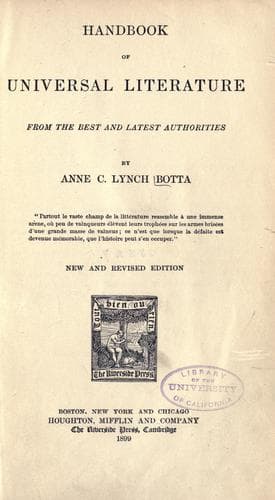
Handbook of Universal Literature, From the Best and Latest AuthoritiesBotta, Anne C. Lynch (Anne Charlotte Lynch)
History
Handbook of Universal Literature, From the Best and Latest Authorities
Botta, Anne C. Lynch (Anne Charlotte Lynch)
Literature -- History and criticism
Netherlands, Poland, Hungary, and the East Indies, found Italian authors
in this age to digest and arrange their chronicles, and give them
historical form.
To this period belong also the "Lives of the Most Celebrated Artists,"
written by Vasari (1512-1574), himself a distinguished artist, a work
highly interesting for its subject and style, and the Autobiography of
Benvenuto Cellini (b. 1500), one of the most curious works which was ever
written in any language.
10. GRAMMAR AND RHETORIC.--The Italian language was used both in writing
and conversation for three centuries before its rules and principles were
reduced to a scientific form. Bembo was the first scholar who established
the grammar. Grammatical writings and researches were soon multiplied and
extended. Salviati was one of the most prominent grammarians of the
sixteenth century, and Buonmattei and Cinonio of the seventeenth. But the
progress in this study was due less to the grammarians than to the
_Dictionary della Crusca_. Among the scholars who took part in the
exercises of the Florentine Academy, founded by Cosmo de' Medici, there
were some who, dissatisfied with the philosophical disputations which were
the object of this institution, organized another association for the
purpose of giving a new impulse to the study of the language. This
academy, inaugurated in 1587, was called _della Crusca_, literally, _of
the bran_. The object of this new association being to sift all impurities
from the language, a sieve, the emblem of the academy, was placed In the
hall; the members at their meetings sat on flour-barrels, and the chair of
the presiding officer stood on three mill-stones. The first work of the
academy was to compile a universal dictionary of the Italian language,
which was published in 1612. Though the Dictionary della Crusca was
conceived in an exclusive spirit, and admitted, as linguistic authorities,
only writers of the fourteenth century, belonging to Tuscany, it
contributed greatly to the progress of the Italian tongue.
Every university of Italy boasted in the sixteenth century of some
celebrated rhetoricians, all of whom, however, were overshadowed by
Vettori (1499-1585), distinguished for the editions of the Greek and Latin
classics published under his superintendence, and for his commentaries on
the rhetorical books of Aristotle. B. Cavalcanti (1503-1562) was also
celebrated in this department, and his "Rhetoric" is the best work of the
age on that subject.
Public-domain text, read in full here on John Shaqi.
Reviews
Reviews
No reviews yet
Be the first to share your thoughts on this work.
Elsewhere in the archive
Join the Discussion
Join the discussion
Sign in to leave a comment or review.
Sign InorCreate an account