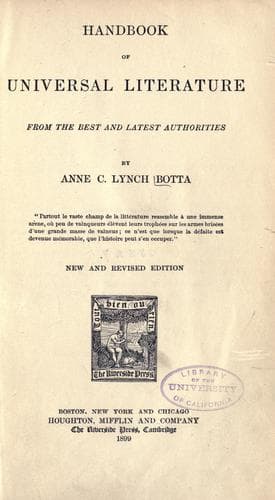
Handbook of Universal Literature, From the Best and Latest AuthoritiesBotta, Anne C. Lynch (Anne Charlotte Lynch)
History
Handbook of Universal Literature, From the Best and Latest Authorities
Botta, Anne C. Lynch (Anne Charlotte Lynch)
Literature -- History and criticism
13. EPIC AND LYRIC POETRY.--Marini (1569-1625), the celebrated innovator
on classic Italian taste, is considered as the first who seduced the poets
of the seventeenth century into a labored and affected style. He was born
at Naples and educated for the legal profession, for which he had little
taste, and on publishing a volume of poems, his indignant father turned
him out of doors. But his popular qualities never left him without
friends. He was invited to the Court of France, obtained the favor of Mary
de' Medici, and the situation of gentleman to the king. He became
exceedingly popular among the French nobility, many of whom learned
Italian for the sole purpose of reading his works. It was here that he
published the most celebrated of his poems, entitled "Adonis." He
afterwards purchased a beautiful villa near Naples, to which he retired,
and where he soon after died. The Adonis of Marini is a mixture of the
epic and the romantic style, the subject being taken from the well-known
story of Venus and Adonis. He renounced all keeping and probability, both
in his incidents and descriptions; if he could present a series of
enchanted pictures, he was little solicitous as to the manner of their
arrangement. But the work has much beauty and imagination, and is often
animated by the true spirit of poetry. Its principal faults are that it is
sadly wire-drawn, and abounds in puns, endless antitheses, and inventions
for surprising or bewildering the reader; graces which were greatly
admired by the contemporaries of the poet. Marini was a voluminous writer,
and was not only extolled in his own country above its classic authors,
and in France, but the Spaniards held him in the highest esteem, and
imitated and even surpassed him in his own eccentric career. He had also
innumerable imitators in Italy, many of whom attained a high reputation
during their lives, and afterwards sank into complete oblivion.
Filicaja (1642-1709) stands at the head of the lyric poets of the
seventeenth century. His inspiration seems first to have been awakened
when Vienna was besieged by the Turks in 1683, and gallantly defended by
the Christian powers. His verses on this occasion awoke the most
enthusiastic admiration, and called forth the eulogies of princes and
poets. The admiration which he excited in his day is scarcely to be
wondered at; for, though this judgment has not been ratified by posterity,
Filicaja has at least the merit of having raised the poetry of Italy from
the abject service of mere amorous imbecility to the noble office of
embodying the more manly and virtuous sentiments; and though his style is
infected with the bombastic spirit of the age, it is even in this respect
singularly moderate, compared with that of his contemporaries.
Public-domain text, read in full here on John Shaqi.
Reviews
Reviews
No reviews yet
Be the first to share your thoughts on this work.
Elsewhere in the archive
Join the Discussion
Join the discussion
Sign in to leave a comment or review.
Sign InorCreate an account