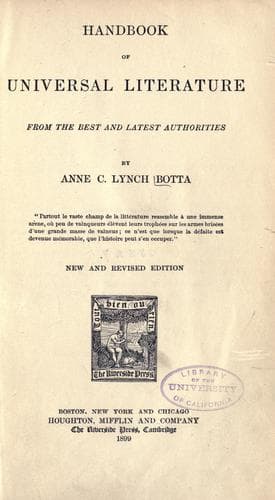
Handbook of Universal Literature, From the Best and Latest AuthoritiesBotta, Anne C. Lynch (Anne Charlotte Lynch)
History
Handbook of Universal Literature, From the Best and Latest Authorities
Botta, Anne C. Lynch (Anne Charlotte Lynch)
Literature -- History and criticism
12. PERIOD OF DECADENCE.--The sixteenth century reaped the fruits that had
been sown in the fifteenth, but it scattered no seeds for a harvest in the
seventeenth, which was therefore doomed to general sterility. In the
reigns of Charles V. and Philip II. the chains of civil and religious
despotism were forged which subdued the intellect and arrested the genius
of the people. The Spanish viceroys ruled with an iron hand over Milan,
Naples, Sicily, and Sardinia. Poverty and superstition wasted and darkened
the minds of the people, and indolence and love of pleasure introduced
almost universal degeneracy. But the Spanish yoke, which weighed so
heavily at both extremities of the Peninsula, did not extend to the
republic of Venice, or to the duchy of Tuscany; and the heroic character
of the princes of Savoy alone would have served to throw a lustre over
this otherwise darkened period. In literature, too, there were a few who
resisted the torrent of bad taste, amidst many who opened the way for a
crowd of followers in the false route, and gave to the age that character
of extravagance for which it is so peculiarly distinguished.
The literary works of the seventeenth century may be divided into three
classes, the first of which, under the guidance of Marini, attained the
lowest degree of corruption, and remain in the annals of literature as
monuments of bombastic style and bad taste. The second embraces those
writers who were aware of the faults of the school to which they belonged,
and who, aiming to bring about a reform in literature, while they
endeavored to follow a better style, partook more or less of the character
of the age. To this class may be referred Chiabrera already named, and
more particularly Filicaja and other poets of the same school. The third
class is composed of a few writers who preserved themselves faithful to
the principles of true taste, and among them are Menzini, Salvator Rosa,
Redi, and more particularly Tassoni.
Public-domain text, read in full here on John Shaqi.
Reviews
Reviews
No reviews yet
Be the first to share your thoughts on this work.
Elsewhere in the archive
Join the Discussion
Join the discussion
Sign in to leave a comment or review.
Sign InorCreate an account