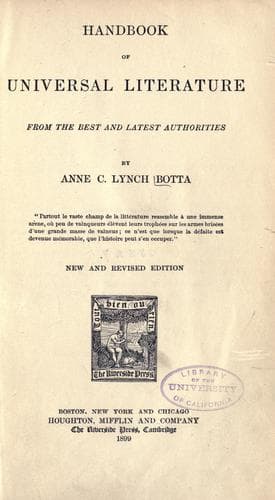
Handbook of Universal Literature, From the Best and Latest AuthoritiesBotta, Anne C. Lynch (Anne Charlotte Lynch)
History
Handbook of Universal Literature, From the Best and Latest Authorities
Botta, Anne C. Lynch (Anne Charlotte Lynch)
Literature -- History and criticism
1. HISTORICAL DEVELOPMENT OF THE THIRD PERIOD.--At the close of the
seventeenth century, a new dawn arose in the history of Italian letters,
and the general corruption which had extended to every branch of
literature and paralyzed the Italian mind began to be arrested by the
appearance of writers of better taste; the affectations of the Marinists
and of the so-called Arcadian poets were banished from literature; science
was elevated and its dominion extended, the melodrama, comedy, and tragedy
recreated, and a new spirit infused into every branch of composition.
Amidst the clash of arms and the vicissitudes of long and bloody wars,
Italy began to awake from her lethargy to the aspiration for greater and
better things, and her intellectual condition soon underwent important
changes and improvements. In the eighteenth century, in Naples, Vico
transformed history into a new science. Filangeri contended with
Montesquieu for the palm of legislative philosophy; and new light was
thrown on criminal science by Mario Pagano. In Rome, letters and science
flourished under the patronage of Benedict XIV., Clement XIV., and Pius
VI., under whose auspices Quirico Visconti undertook his "Pio Clementine
Museum" and his "Greek and Roman Iconography," the two greatest
archaeological works of all ages. Padua was immortalized by the works of
Cesarotti, Belzoni, and Stratico; Venice by Goldoni; Verona by Maffei, the
critic and the antiquarian, as well as the first reformer of Italian
tragedy. Tuscany took the lead of the intellectual movement of the country
under Leopold and his successor Ferdinand, when Florence, Pisa, and Siena
again became seats of learning and of poetry and the arts. Maria Theresa
and Joseph II. fostered the intellectual progress of Lombardy; Spallanzani
published his researches on natural philosophy; Volta discovered the pile
which bears his name; a new era in poetry was created by Parinl; another
in criminal jurisprudence by Beccaria; history was reconstructed by
Muratori; mathematics promoted by Lagrange, and astronomy by Oriani; and
Alfieri restored Italian letters to their primitive splendor.
Public-domain text, read in full here on John Shaqi.
Reviews
Reviews
No reviews yet
Be the first to share your thoughts on this work.
Elsewhere in the archive
Join the Discussion
Join the discussion
Sign in to leave a comment or review.
Sign InorCreate an account