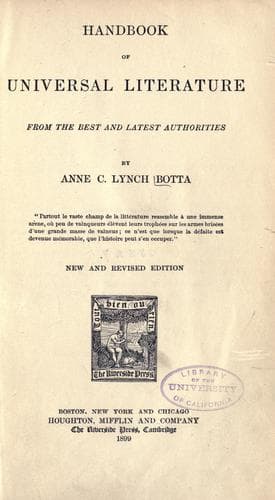
Handbook of Universal Literature, From the Best and Latest AuthoritiesBotta, Anne C. Lynch (Anne Charlotte Lynch)
History
Handbook of Universal Literature, From the Best and Latest Authorities
Botta, Anne C. Lynch (Anne Charlotte Lynch)
Literature -- History and criticism
But at the close of the eighteenth century and the beginning of the
nineteenth, Italy became the theatre of political and military
revolutions, whose influence could not fail to arrest the development of
the literature of the country. The galleries, museums, and libraries of
Rome, Florence, and other cities suffered from the military occupation,
and many of their treasures, manuscripts, and masterpieces of art were
carried to Paris by command of Napoleon. The entire peninsula was subject
to French influence, which, though beneficial to its material progress,
could not fail to be detrimental to national literature. All new works
were composed in French, and indifferent or bad translations from the
French were widely circulated; the French language was substituted for the
Italian, and the national literature seemed about to disappear. But
Italian genius was not wholly extinguished; a few writers powerfully
opposed this new tendency, and preserved in its purity the language of
Dante and Petrarch. Gradually the national spirit revived, and literature
was again moulded in accordance with the national character.
Notwithstanding the political calamities of which, for some time after the
treaty of Vienna in 1815, Italy was continually the victim, the literature
of the country awakened and fostered a sentiment of nationality, and
Italian independence is at this present moment already achieved.
2. THE MELODRAMA.--The first result of the revival of letters at the close
of the seventeenth century was the reform of the theatre. The melodrama,
or Italian opera, arose out of the pastoral drama, which it superseded.
The astonishing progress of musical science succeeded that of poetry and
sculpture, which fell into decline with the decay of literature. Music,
rising into excellence and importance at a time when poetry was on the
decline, acquired such superiority that verse, instead of being its
mistress, became its handmaid. The first occasion of this inversion was in
the year 1594, when Rinuccini, a Florentine poet, associated himself with
three musicians to compose a mythological drama. This and several other
pieces by the same author met with a brilliant reception. Poetry, written
only in order to be sung, thus assumed a different character; Rinuiccini
abandoned the form of the canzone which had hitherto been used in the
lyrical part of the drama, and adopted the Pindaric ode. Many poets
followed in the same path; more action was given to the dramatic parts,
and greater variety to the music, in which the airs were agreeably blended
with the recitative duets; other harmonized pieces were also added, and
after the lapse of a century Apostolo Zeno (1669-1750) still further
improved the melodrama. But it was the spirit of Metastasio that breathed
a soul of fire into this ingenious and happy form created by others.
Public-domain text, read in full here on John Shaqi.
Reviews
Reviews
No reviews yet
Be the first to share your thoughts on this work.
Elsewhere in the archive
Join the Discussion
Join the discussion
Sign in to leave a comment or review.
Sign InorCreate an account