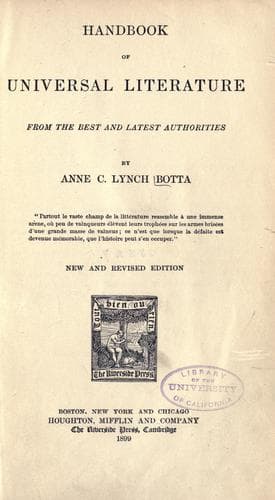
Handbook of Universal Literature, From the Best and Latest AuthoritiesBotta, Anne C. Lynch (Anne Charlotte Lynch)
History
Handbook of Universal Literature, From the Best and Latest Authorities
Botta, Anne C. Lynch (Anne Charlotte Lynch)
Literature -- History and criticism
During the last twenty-five years the rapid progress of political events
in Italy seems to have absorbed the energies of the people, who have made
little advance in literature. For the first time since the fall of the
Roman empire the country has become a united kingdom, and in the national
adjustment to the new conditions, and in the material and industrial
development which has followed, the new literature has not yet, to any
great extent, found voice. Yet this period of national formation and
consolidation, however, has not been without its poets, among whom a few
may be here named. Aleardo Aleardi (d. 1882) is one of the finest poetical
geniuses that Italy has produced within the last century, but his writings
show the ill effects of a poet sacrificing his art to a political cause,
and when the patriot has ceased to declaim the poet ceases to sing. Prati
(1815-1884), on the other hand, in his writings exemplifies the evil of a
poet refusing to take part in the grand movement of his nation. He severs
himself from all present interests and finds his subjects in sources which
have no interest for his contemporaries. He has great metrical facility
and his lyrics are highly praised. Carducci, like Aleardi, is a poet who
has written on political subjects; he belongs to the class of closet
democrats. His poems display a remarkable talent for the picturesque,
forcible, and epigrammatic. The poems of Zanella are nearly all on
scientific subjects connected with human feeling, and entitle him to a
distinguished place among the refined poets of his country. A poet of
greater promise than those already spoken of is Arnaboldi, who has the
endowment requisite to become the first Italian poet of a new school, but
who endangers his position by devoting his verse to utilitarian purposes.
The tendency of the younger poets is to realism and to representing its
most materialistic features as beautiful. Against this current of the new
poetry Alessandro Rizzi, Guerzoni, and others have uttered a strong
protest in poetry and prose.
Among historians, Capponi is the author of a history of Florence; Zini has
continued Farina's history of Italy; Bartoli, Settembrini, and De Sanctis
have written histories of Italian literature; Villari is the author of
able works on the life of Machiavelli and of Savonarola, and Berti has
written the life of Giordano Bruno. In criticism philosophic, historical,
and literary, Fiorentino, De Sanctis, Massarani, and Trezza are
distinguished. Barili, Farina, Bersezio, and Giovagnoli are writers of
fiction, and Cossa, Ferrari, and Giacosa are the authors of many dramatic
works. The charming books of travel by De Amicis are extensively
translated and very popular.
FRENCH LITERATURE.
INTRODUCTION.--1. French Literature and its Divisions.--2. The Language.
Public-domain text, read in full here on John Shaqi.
Reviews
Reviews
No reviews yet
Be the first to share your thoughts on this work.
Elsewhere in the archive
Join the Discussion
Join the discussion
Sign in to leave a comment or review.
Sign InorCreate an account