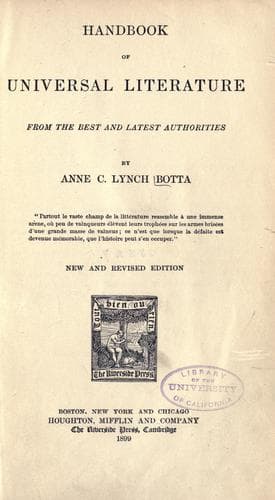
Handbook of Universal Literature, From the Best and Latest AuthoritiesBotta, Anne C. Lynch (Anne Charlotte Lynch)
History
Handbook of Universal Literature, From the Best and Latest Authorities
Botta, Anne C. Lynch (Anne Charlotte Lynch)
Literature -- History and criticism
While sensualism was gaining ground in the seventeenth and eighteenth
centuries, rationalism, having its roots in the Platonic system which had
prevailed in the fifteenth and sixteenth, was remodeled under the
influence of Descartes, Leibnitz, and Wolf, and opposed to the invading
tendencies of its antagonist. From causes to be found in the spirit of the
age and the political condition of the country, this system was unable to
take the place to which it was entitled, though it succeeded in purifying
sensualism from its more dangerous consequences, and infusing into it some
of its own elements. But the overthrow of that system was completed only
by the works of Rosmini and Gioberti. Rosmini (1795-1855) gave a new
impulse to metaphysical researches, and created a new era in the history
of Italian philosophy. His numerous works embrace all philosophical
knowledge in its unity and universality, founded on a new basis, and
developed with deep, broad, and original views. His philosophy, both
inductive and deductive, rests on experimental method, reaches the highest
problems of ideology and ontology, and infuses new life into all
departments of science. This philosophical progress was greatly aided by
Gioberti (1801-1851), whose life, however, was more particularly devoted
to political pursuits. His work on "The Regeneration of Italy" contains
his latest and soundest views on Italian nationality. Another
distinguished philosophical and political writer is Mamiani, whose work on
"The Rights of Nations" deserves the attention of all students of history
and political science. As a statesman, he belongs to the National party,
of which Count Cavour (1810-1861), himself an eminent writer on political
economy, was the great representative, and to whose commanding influence
is to be attributed the rapid progress which the Italian nation was making
towards unity and independence at the time of his death.
FROM 1860 TO 1885.
Public-domain text, read in full here on John Shaqi.
Reviews
Reviews
No reviews yet
Be the first to share your thoughts on this work.
Elsewhere in the archive
Join the Discussion
Join the discussion
Sign in to leave a comment or review.
Sign InorCreate an account