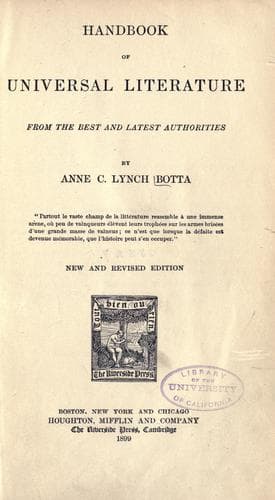
Handbook of Universal Literature, From the Best and Latest AuthoritiesBotta, Anne C. Lynch (Anne Charlotte Lynch)
History
Handbook of Universal Literature, From the Best and Latest Authorities
Botta, Anne C. Lynch (Anne Charlotte Lynch)
Literature -- History and criticism
In the south of France, Provence early became an independent kingdom, and
consolidating its language, laws, and manners, at the close of the
eleventh century it gave birth to the literature of the Troubadours; while
in the north, the language and literature of the Trouvères, which were the
germs of the national literature of France, were not developed until a
century later.
In the schools established by Charlemagne for the education of the clergy,
the scholastic philosophy originated, which prevailed throughout Europe in
the Middle Ages. The most distinguished schoolmen or scholastics in France
during this period are Roscellinus (fl. 1092), the originator of the
controversy between the Nominalists and Realists, which occupied so
prominent a place in the philosophy of the time; Abelard (1079-1142),
equally celebrated for his learning, and for his unfortunate love for
Héloïse; St. Bernard (1091-1153), one of the most influential
ecclesiastics of the Middle Ages; and Thomas Aquinas (1227-1274) and
Bonaventure (1221-1274), Italians who taught theology and philosophy at
Paris, and who powerfully influenced the intellect of the age.
Beginning with the Middle Ages, the literary history of France may be
divided into three periods. The first period extends from 1000 to 1500,
and includes the literature of the Troubadours, the Trouvères, and of the
fifteenth century.
The second period extends from 1500 to 1700, and includes the revival of
the study of classical literature, or the Renaissance, and the golden age
of French literature under Louis XIV.
The third period, extending from 1700 to 1885, comprises the age of
skepticism introduced into French literature by Voltaire, the
Encyclopaedists and others, the Revolutionary era, the literature of the
Empire and of the Restoration, of the Second Empire, and of the present
time.
Public-domain text, read in full here on John Shaqi.
Reviews
Reviews
No reviews yet
Be the first to share your thoughts on this work.
Elsewhere in the archive
Join the Discussion
Join the discussion
Sign in to leave a comment or review.
Sign InorCreate an account