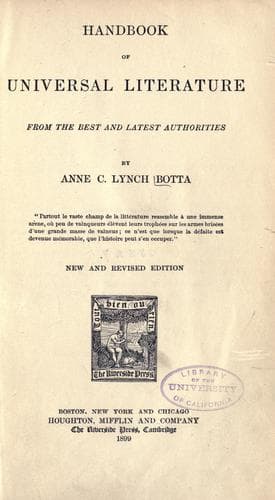
Handbook of Universal Literature, From the Best and Latest AuthoritiesBotta, Anne C. Lynch (Anne Charlotte Lynch)
History
Handbook of Universal Literature, From the Best and Latest Authorities
Botta, Anne C. Lynch (Anne Charlotte Lynch)
Literature -- History and criticism
2. THE LANGUAGE.--After the conquest of Gaul by Julius Caesar, Latin
became the predominant language of the country; but on the overthrow of
the Western Empire it was corrupted by the intermixture of elements
derived from the northern invaders of the country, and from the general
ignorance and barbarism of the times. At length a distinction was drawn
between the language of the Gauls who called themselves Romans, and that
of the Latin writers; and the _Romance_ language arose from the former,
while the Latin was perpetuated by the latter. At the commencement of the
second race of monarchs, German was the language of Charlemagne and his
court, Latin was the written language, and the Romance, still in a state
of barbarism, was the dialect of the people. The subjects of Charlemagne
were composed of two different races, the Germans, inhabiting along and
beyond the Rhine, and the Wallons, who called themselves Romans. The name
of _Welsch_ or _Wallons_, given them by the Germans, was the same as
_Galli_, which they had received from the Latins, and as _Keltai_ or
Celts, which they themselves acknowledged. The language which they spoke
was called after them the _Romance-Wallon_, or rustic Romance, which was
at first very much the same throughout France, except that as it extended
southward the Latin prevailed, and in the north the German was more
perceptible. These differences increased, and the languages rapidly grew
more dissimilar. The people of the south called themselves _Romans-
provençaux_, while the northern tribes added to the name of Romans, which
they had assumed, that of _Wallons_, which they had received from the
neighboring people. The Provençal was called the _Langue d'oc_, and the
Wallon the _Langue d'oui_, from the affirmative word in each language, as
the Italian was then called the _Langue de sí_, and the German the _Langue
de ya_.
The invasion of the Normans, in the tenth century, supplied new elements
to the Romance Wallon. They adopted it as their language, and stamped upon
it the impress of their own genius. It thus became Norman-French. In 1066,
William the Conqueror introduced it into England, and enforced its use
among his new subjects by rigorous laws; thus the popular French became
there the language of the court and of the educated classes, while it was
still the vulgar dialect in France.
Public-domain text, read in full here on John Shaqi.
Reviews
Reviews
No reviews yet
Be the first to share your thoughts on this work.
Elsewhere in the archive
Join the Discussion
Join the discussion
Sign in to leave a comment or review.
Sign InorCreate an account