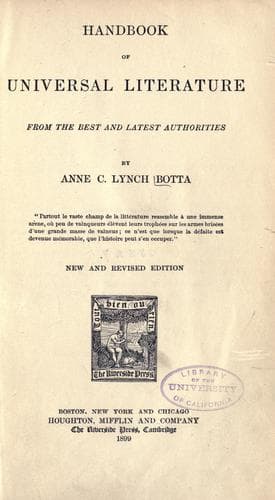
Handbook of Universal Literature, From the Best and Latest AuthoritiesBotta, Anne C. Lynch (Anne Charlotte Lynch)
History
Handbook of Universal Literature, From the Best and Latest Authorities
Botta, Anne C. Lynch (Anne Charlotte Lynch)
Literature -- History and criticism
1. THE TROUBADOURS.--When, in the tenth century, the nations of the south
of Europe attempted to give consistency to the rude dialects which had
been produced by the mixture of the Latin with the northern tongues, the
Provencal, or _Langue d'oc_, was the first to come to perfection. The
study of this language became the favorite recreation of the higher
classes during the tenth and eleventh centuries, and poetry the elegant
occupation of those whose time was not spent in the ruder pastimes of the
field. Thousands of poets, who were called troubadours (from _trobar_, to
find or invent), flourished in this new language almost contemporaneously,
and spread their reputation from the extremity of Spain to that of Italy.
All at once, however, this ephemeral reputation vanished. The voice of the
troubadours was silent, the Provençal was abandoned and sank into a mere
dialect, and after a brilliant existence of three centuries (950-1250),
its productions were ranked among those of the dead languages. The high
reputation of the Provençal poets, and the rapid decline of their
language, are two phenomena equally striking in the history of human
culture. This literature, which gave models to other nations, yet among
its crowds of agreeable poems did not produce a single masterpiece
destined to immortality, was entirely the offspring of the age, and not of
individuals. It reveals to us the sentiments and imagination of modern
nations in their infancy; it exhibits what was common to all and pervaded
all, and not what genius superior to the age enabled a single individual
to accomplish.
Southern France, having been the inheritance of several of the successors
of Charlemagne, was elevated to the rank of an independent kingdom in 879,
by Bozon, and under his sovereignty, and that of his successors for 213
years, it enjoyed a paternal government. The accession of the Count of
Barcelona to the crown, in 1092, introduced into Provence the spirit both
of liberty and chivalry, and a taste for elegance and the arts, with all
the sciences of the Arabians. The union of these noble sentiments added
brilliancy to that poetical spirit which shone out at once over Provence
and all the south of Europe, like an electric flash in the midst of
profound darkness, illuminating all things with the splendor of its flame.
Public-domain text, read in full here on John Shaqi.
Reviews
Reviews
No reviews yet
Be the first to share your thoughts on this work.
Elsewhere in the archive
Join the Discussion
Join the discussion
Sign in to leave a comment or review.
Sign InorCreate an account