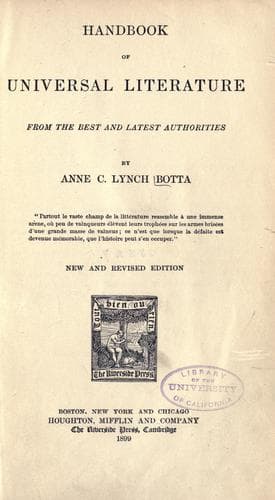
Handbook of Universal Literature, From the Best and Latest AuthoritiesBotta, Anne C. Lynch (Anne Charlotte Lynch)
History
Handbook of Universal Literature, From the Best and Latest Authorities
Botta, Anne C. Lynch (Anne Charlotte Lynch)
Literature -- History and criticism
At the same time with Provençal poetry, chivalry had its rise; it was, in
a manner, the soul of the new literature, and gave to it a character
different from anything in antiquity. Love, in this age, while it was not
more tender and passionate than among the Greeks and Romans, was more
respectful, and women were regarded with something of that religious
veneration which the Germans evinced towards their prophetesses. To this
was added that passionate ardor of feeling peculiar to the people of the
South, the expression of which was borrowed from the Arabians. But
although among individuals love preserved this pure and religious
character, the license engendered by the feudal system, and the disorders
of the time, produced a universal corruption of manners which found
expression in the literature of the age. Neither the _sirventes_ nor the
_chanzos_ of the troubadours, nor the _fabliaux_ of the trouvères, nor the
romances of chivalry, can be read without a blush. On every page the
grossness of the language is only equaled by the shameful depravity of the
characters and the immorality of the incidents. In the south of France,
more particularly, an extreme laxity of manners prevailed among the
nobility. Gallantry seems to have been the sole object of existence.
Ladies were proud of the celebrity conferred upon their charms by the
songs of the troubadours, and they themselves often professed the "Gay
Science," as poetry was called. They instituted the Courts of Love where
questions of gallantry were gravely discussed and decided by their
suffrages; and they gave, in short, to the whole south of France the
character of a carnival. No sooner had the Gay Science been established in
Provence, than it became the fashion in surrounding countries. The
sovereigns of Europe adopted the Provençal language, and enlisted
themselves among the poets, and there was soon neither baron nor knight
who did not feel himself bound to add to his fame as a warrior the
reputation of a gentle troubadour. Monarchs were now the professors of the
art, and the only patrons were the ladies. Women, no longer beautiful
ciphers, acquired complete liberty of action, and the homage paid to them
amounted almost to worship.
Public-domain text, read in full here on John Shaqi.
Reviews
Reviews
No reviews yet
Be the first to share your thoughts on this work.
Elsewhere in the archive
Join the Discussion
Join the discussion
Sign in to leave a comment or review.
Sign InorCreate an account