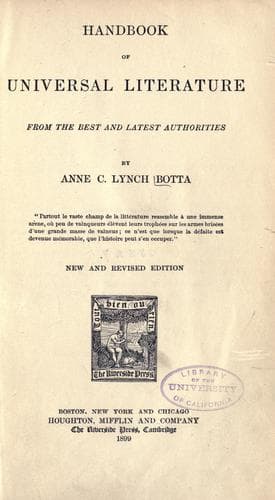
Handbook of Universal Literature, From the Best and Latest AuthoritiesBotta, Anne C. Lynch (Anne Charlotte Lynch)
History
Handbook of Universal Literature, From the Best and Latest Authorities
Botta, Anne C. Lynch (Anne Charlotte Lynch)
Literature -- History and criticism
At the festivals of the haughty barons, the lady of the castle, attended
by youthful beauties, distributed crowns to the conquerors in the jousts
and tournaments. She then, in turn, surrounded by her ladies, opened her
Court of Love, and the candidates for poetical honors entered with their
harps and contended for the prize in extempore verses called _tensons_.
The Court of Love then entered upon a grave discussion of the merits of
the question, and a judgment or _arrêt d'amour_ was given, frequently in
verse, by which the dispute was supposed to be decided. These courts often
formally justified the abandonment of moral duty, and assuming the forms
and exercising the power of ordinary tribunals, they defined and
prescribed the duties of the sexes, and taught the arts of love and song
according to the most depraved moral principles, mingled, however, with an
affected display of refined sentimentality. Whatever may have been their
utility in the advancement of the language and the cultivation of literary
taste, these institutions extended a legal sanction to vice, and
inculcated maxims of shameful profligacy.
The songs of the Provençals were divided into _chanzos_ and _sirventes_;
the object of the former was love, and of the latter war, politics, or
satire. The name of _tenson_ was given to those poetical contests in verse
which took place in the Courts of Love, or before illustrious princes. The
songs were sung from château to château, either by the troubadours
themselves, or by the _jongleur_ or instrument player by whom they were
attended; they often abounded in extravagant hyperboles, trivial conceits,
and grossness of expression. Ladies, whose attractions were estimated by
the number and desperation of their lovers, and the songs of their
troubadours, were not offended if licentiousness mingled with gallantry in
the songs composed in their praise. Authors addressed prayers to the
saints for aid in their amorous intrigues, and men, seemingly rational,
resigned themselves to the wildest transports of passion for individuals
whom, in some cases, they had never seen. Thus, religious enthusiasm,
martial bravery, and licentious love, so grotesquely mingled, formed the
very life of the Middle Ages, and impossible as it is to transfuse into a
translation the harmony of Provençal verse, or to find in it, when
stripped of this harmony, any poetical idea, these remains are valuable
since they present us with a picture of the life and manners of the times.
The intercourse of the Provençals with the Moors of Spain, which, as we
have seen, was greatly increased by the union of Catalonia and Provence
(1092), introduced into the North an acquaintance with the arts and
learning of the Arabians. It was then that rhyme, the essential
characteristic of Arabian poetry, was adopted by the troubadours into the
Provençal language, and thence communicated to the nations of modern
Europe.
Public-domain text, read in full here on John Shaqi.
Reviews
Reviews
No reviews yet
Be the first to share your thoughts on this work.
Elsewhere in the archive
Join the Discussion
Join the discussion
Sign in to leave a comment or review.
Sign InorCreate an account