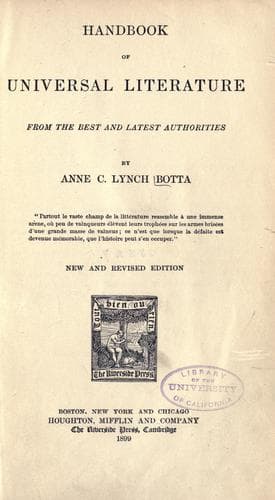
Handbook of Universal Literature, From the Best and Latest AuthoritiesBotta, Anne C. Lynch (Anne Charlotte Lynch)
History
Handbook of Universal Literature, From the Best and Latest Authorities
Botta, Anne C. Lynch (Anne Charlotte Lynch)
Literature -- History and criticism
After the thirteenth century, the troubadours were heard no more, and the
efforts of the counts of Provence, the magistrates of Toulouse, and the
kings of Arragon to awaken, their genius by the Courts of Love and the
Floral Games were vain. They themselves attributed their decline to the
degradation into which the jongleurs, with whom at last they were
confounded, had fallen. But their art contained within itself a more
immediate principle of decay in the profound ignorance of its professors.
They had no other models than the songs of the Arabians, which perverted
their taste. They made no attempt at epic or dramatic poetry; they had no
classical allusions, no mythology, nor even a romantic imagination, and,
deprived of the riches of antiquity, they had few resources within
themselves. The poetry of Provence was a beautiful flower springing up on
a sterile soil, and no cultivation could avail in the absence of its
natural nourishment. From the close of the twelfth century the language
began to decline, and public events occurred which hastened its downfall,
and reduced it to the condition of a provincial dialect.
Among the numerous sects which sprang up in Christendom during the Middle
Ages, there was one which, though bearing different names at different
times, more or less resembled what is now known as Protestantism; in the
twelfth and thirteenth centuries it was called the faith of the
Albigenses, as it prevailed most widely in the district of Albi. It easily
came to be identified with the Provençal language, as this was the chosen
vehicle of its religious services. This sect was tolerated and protected
by the Court of Toulouse. It augmented its numbers; it devoted itself to
commerce and the arts, and added much to the prosperity which had long
distinguished the south of France. The Albigenses had lived long and
peaceably side by side with the Catholics in the cities and villages; but
Innocent III. sent legates to Provence, who preached, discussed, and
threatened, and met a freedom of thought and resistance to authority which
Rome was not willing to brook. Bitter controversy was now substituted for
the amiable frivolity of the _tensons_, and theological disputes
superseded those on points of gallantry. The long struggle between the
poetry of the troubadours and the preaching of the monks came to a crisis;
the severe satires which the disorderly lives of the clergy called forth
became severer still, and the songs of the troubadours wounded the power
and pride of Rome more deeply than ever, while they stimulated the
Albigenses to a valiant resistance or a glorious death. A crusade
followed, and when the dreadful strife was over, Provençal poetry had
received its death-blow. The language of Provence was destined to share
the fate of its poetry; it became identified in the minds of the orthodox
with heresy and rebellion. When Charles of Anjou acquired the kingdom of
Naples, he drew thither the Provençal nobility, and thus drained the
Public-domain text, read in full here on John Shaqi.
Reviews
Reviews
No reviews yet
Be the first to share your thoughts on this work.
Elsewhere in the archive
Join the Discussion
Join the discussion
Sign in to leave a comment or review.
Sign InorCreate an account