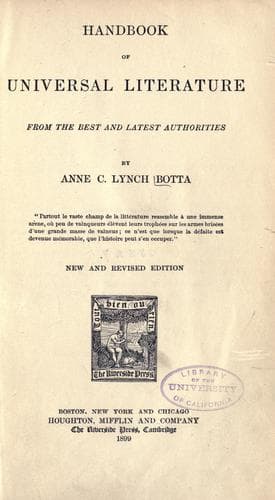
Handbook of Universal Literature, From the Best and Latest AuthoritiesBotta, Anne C. Lynch (Anne Charlotte Lynch)
History
Handbook of Universal Literature, From the Best and Latest Authorities
Botta, Anne C. Lynch (Anne Charlotte Lynch)
Literature -- History and criticism
kingdom of those who had formerly maintained its chivalrous manners. In
the beginning of the fourteenth century, when the Court of Rome was
removed to Avignon, the retinues of the three successive popes were
Italians, and the Tuscan language entirely superseded the Provençal among
the higher classes.
2. THE TROUVÈRES.--While the Provençal was thus relapsing into a mere
dialect, the north of France was maturing a new language and literature of
an entirely different character. Normandy, a province of France, was
invaded in the tenth century by a new northern tribe, who, under the
command of Rollo or Raoul the Dane, incorporated themselves with the
ancient inhabitants. The victors adopted the language of the vanquished,
stamped upon it the impress of their own genius, and gave it a fixed form.
It was from Normandy that the first writers and poets in the French
language sprang. While the Romance Provençal spoken in the South was
sweet, and expressive of effeminate manners, the Romance-Wallon was
energetic and warlike, and represented the severer manners of the Germans.
Its poetry, too, was widely different from the Provençal. It was no longer
the idle baron sighing for his lady-love, but the songs of a nation of
hardy warriors, celebrating the prowess of their ancestors with all the
exaggerations that fancy could supply. The _Langue d'oui_ became the
vehicle of literature only in the twelfth century,--a hundred years
subsequent to the Romance Provençal. The poets and reciters of tales,
giving the name of Troubadour a French termination, called themselves
Trouvères. They originated the brilliant romances of chivalry, the
_fabliaux_ or tales of amusement, and the dramatic invention of the
Mysteries. The first literary work in this tongue is the versified romance
of a fabulous history of the early kings of England, beginning with
Brutus, the grandson of AEneas, who, after passing many enchanted isles,
at length establishes himself in England, where he finds King Arthur, the
chivalric institution of the Round Table, and the enchanter Merlin, one of
the most popular personages of the Middle Ages. Out of this legend arose
some of the boldest creations of the human fancy. The word "romance," now
synonymous with fictitious composition, originally meant only a work in
the modern dialect, as distinguished from the scholastic Latin. There is
little doubt that these tales were originally believed to be strictly
true. One of the first romances of chivalry was "Tristam de Léonois,"
written in 1190. This was soon followed by that of the "San Graal" and
"Lancelot;" and previously to 1213 Ville-Hardouin had written in the
French language a "History of the Conquest of Constantinople." The poem of
"Alexander," however, which appeared about the same time, has enjoyed the
greatest reputation. It is a series of romances and marvelous histories,
said to be the result of the labors of nine celebrated poets of the time.
Public-domain text, read in full here on John Shaqi.
Reviews
Reviews
No reviews yet
Be the first to share your thoughts on this work.
Elsewhere in the archive
Join the Discussion
Join the discussion
Sign in to leave a comment or review.
Sign InorCreate an account