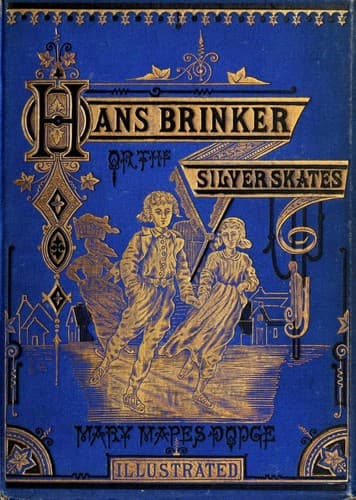
Hans Brinker; Or, The Silver SkatesDodge, Mary Mapes
History
Hans Brinker; Or, The Silver Skates
Dodge, Mary Mapes
Netherlands -- History -- 19th century -- Juvenile fiction; Siblings -- Juvenile fiction; Skating -- Juvenile fiction
In the Spring there is always great danger of inland freshets,
especially in times of thaw, because the rivers, choked with blocks of
ice, overflow before they can discharge their rapidly rising waters into
the ocean. Added to this, the sea chafing and pressing against the
dykes, it is no wonder that Holland is often in a state of alarm. The
greatest care is taken to prevent accidents. Engineers and workmen are
stationed all along in threatened places and a close watch is kept up
night and day. When a general signal of danger is given, the inhabitants
all rush to the rescue, eager to combine against their common foe. As,
everywhere else, straw is supposed to be of all things the most helpless
in the water, of course in Holland it must be rendered the mainstay
against a rushing tide. Huge straw mats are pressed against the
embankments, fortified with clay and heavy stone, and once adjusted, the
ocean dashes against them in vain.
Raff Brinker, the father of Gretel and Hans, had for years been employed
upon the dykes. It was at the time of a threatened inundation, when in
the midst of a terrible storm, in darkness and sleet, the men were
laboring at a weak spot near the Veermyk sluice, that he fell from the
scaffolding, and was taken home insensible. From that hour he never
worked again; though he lived on, mind and memory were gone.
Gretel could not remember him otherwise than as the strange, silent man,
whose eyes followed her vacantly whichever way she turned; but Hans had
recollections of a hearty, cheerful-voiced father who was never tired of
bearing him upon his shoulder, and whose careless song still seemed
echoing near when he lay awake at night and listened.
III
THE SILVER SKATES
Dame Brinker earned a scanty support for her family by raising
vegetables, spinning and knitting. Once she had worked on board the
barges plying up and down the canal, and had occasionally been harnessed
with other women to the towing rope of a pakschuyt plying between Broek
and Amsterdam. But when Hans had grown strong and large, he had insisted
upon doing all such drudgery in her place. Besides, her husband had
become so very helpless of late, that he required her constant care.
Although not having as much intelligence as a little child, he was yet
strong of arm and very hearty, and Dame Brinker had sometimes great
trouble in controlling him.
"Ah! children, he was so good and steady," she would sometimes say, "and
as wise as a lawyer. Even the Burgomaster would stop to ask him a
question, and now alack! he don't know his wife and little ones. You
remember the father, Hans, when he was himself--a great brave man--don't
you?"
"Yes, indeed, mother, he knew everything, and could do anything under
the sun--and how he would sing! why, you used to laugh and say it was
enough to set the windmills dancing."
Public-domain text, read in full here on John Shaqi.
Reviews
Reviews
No reviews yet
Be the first to share your thoughts on this work.
Join the Discussion
Join the discussion
Sign in to leave a comment or review.
Sign InorCreate an account