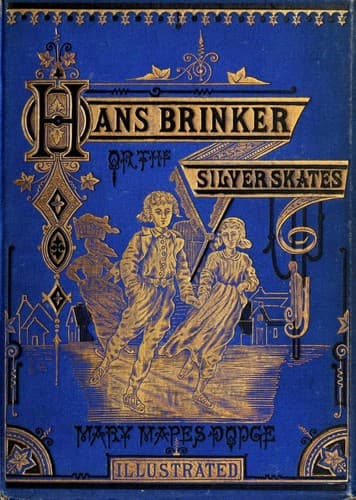
Hans Brinker; Or, The Silver SkatesDodge, Mary Mapes
History
Hans Brinker; Or, The Silver Skates
Dodge, Mary Mapes
Netherlands -- History -- 19th century -- Juvenile fiction; Siblings -- Juvenile fiction; Skating -- Juvenile fiction
There was the rich burgomaster's daughter Hilda van Gleck, with her
costly furs and loose-fitting velvet sack; and, near by, a pretty
peasant girl, Annie Bouman, jauntily attired in a coarse scarlet jacket
and a blue skirt just short enough to display the gray homespun hose to
advantage. Then there was the proud Rychie Korbes, whose father, Mynheer
van Korbes, was one of the leading men of Amsterdam; and, flocking
closely around her, Carl Schummel, Peter and Ludwig[7] van Holp, Jacob
Poot, and a very small boy rejoicing in the tremendous name of
Voostenwalbert Schimmelpenninck. There were nearly twenty other boys and
girls in the party, and one and all seemed full of excitement and
frolic.
[Footnote 7: Ludwig, Gretel, and Carl were named after German friends.
The Dutch form would be Lodewyk, Grietje and Karel.]
[Illustration: _Hans was clever at carving in wood_]
Up and down the canal, within the space of a half mile they skated,
exerting their racing powers to the utmost. Often the swiftest among
them was seen to dodge from under the very nose of some pompous
law-giver or doctor, who with folded arms was skating leisurely toward
the town; or a chain of girls would suddenly break at the approach of a
fat old burgomaster who, with gold-headed cane poised in air, was
puffing his way to Amsterdam. Equipped in skates wonderful to behold,
from their superb strappings, and dazzling runners curving over the
instep and topped with gilt balls, he would open his fat eyes a little
if one of the maidens chanced to drop him a courtesy, but would not dare
to bow in return for fear of losing his balance.
Not only pleasure-seekers and stately men of note were upon the canal.
There were work-people, with weary eyes, hastening to their shops and
factories; market-women with loads upon their heads; peddlers bending
with their packs; barge-men with shaggy hair and bleared faces, jostling
roughly on their way; kind-eyed clergymen speeding perhaps to the
bedsides of the dying; and, after a while, groups of children, with
satchels slung over their shoulders, whizzing past, toward the distant
school. One and all wore skates excepting, indeed, a muffled-up farmer
whose queer cart bumped along on the margin of the canal.
Before long our merry boys and girls were almost lost in the confusion
of bright colors, the ceaseless motion, and the gleaming of skates
flashing back the sunlight. We might have known no more of them had not
the whole party suddenly come to a standstill and, grouping themselves
out of the way of the passers-by, all talked at once to a pretty little
maiden, whom they had drawn from the tide of people flowing toward the
town.
"Oh Katrinka!" they cried, in a breath, "have you heard of it? The
race--We want you to join!"
"What race?" asked Katrinka, laughing--"Don't all talk at once, please,
I can't understand."
Every one panted and looked at Rychie Korbes, who was their acknowledged
spokeswoman.
Public-domain text, read in full here on John Shaqi.
Reviews
Reviews
No reviews yet
Be the first to share your thoughts on this work.
Join the Discussion
Join the discussion
Sign in to leave a comment or review.
Sign InorCreate an account