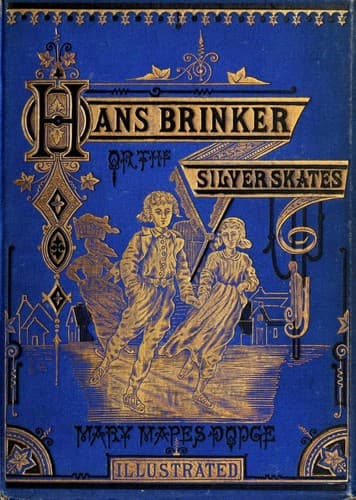
Hans Brinker; Or, The Silver SkatesDodge, Mary Mapes
History
Hans Brinker; Or, The Silver Skates
Dodge, Mary Mapes
Netherlands -- History -- 19th century -- Juvenile fiction; Siblings -- Juvenile fiction; Skating -- Juvenile fiction
If you all could be here with me to-day, what fine times we might have
walking through this beautiful Dutch city! How we should stare at the
crooked houses, standing with their gable ends to the street; at the
little slanting mirrors fastened outside of the windows; at the wooden
shoes and dog-carts near by; the windmills in the distance; at the great
warehouses; at the canals, doing the double duty of streets and rivers,
and at the singular mingling of trees and masts to be seen in every
direction. Ah, it would be pleasant, indeed! But here I sit in a great
hotel looking out upon all these things, knowing quite well that not
even the spirit of the Dutch, which seems able to accomplish anything,
can bring you at this moment across the ocean. There is one comfort,
however, in going through these wonderful Holland towns without you--it
would be dreadful to have any of the party tumble into the canals; and
then these lumbering Dutch wagons, with their heavy wheels, so very far
apart: what should I do if a few dozen of you were to fall under _them_?
and, perhaps, one of the wildest of my boys might harm a stork, and then
all Holland would be against us! No. It is better as it is. You will be
coming, one by one, as the years go on, to see the whole thing for
yourselves.
Holland is as wonderful to-day as it was when, more than twenty years
ago, Hans and Gretel skated on the frozen Y. In fact, more wonderful,
for every day increases the marvel of its not being washed away by the
sea. Its cities have grown, and some of its peculiarities have been
brushed away by contact with other nations; but it is Holland still, and
always will be--full of oddity, courage and industry--the pluckiest
little country on earth. I shall not tell you in this letter of its
customs, its cities, its palaces, churches, picture-galleries, and
museums--for these are described in the story--except to say that they
are here still, just the same, in this good year 1873, for I have seen
them nearly all within a week.
To-day an American boy and I seeing some children enter an old house in
the business part of Amsterdam, followed them in--and what do you think
we found? An old woman, here in the middle of summer, selling hot water
and fire! She makes her living by it. All day long she sits tending her
great fires of peat and keeping the shining copper-tanks above them
filled with water. The children who come and go, carry away in a curious
stone pail their kettle of boiling water and their blocks of burning
peat. For these they give her a Dutch cent, which is worth less than
half of one of ours. In this way persons who cannot afford to keep a
fire burning in hot weather, may yet have their cup of tea or coffee and
their bit of boiled fish and potato.
Public-domain text, read in full here on John Shaqi.
Reviews
Reviews
No reviews yet
Be the first to share your thoughts on this work.
Join the Discussion
Join the discussion
Sign in to leave a comment or review.
Sign InorCreate an account