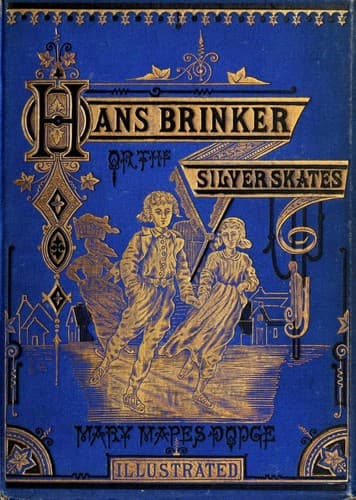
Hans Brinker; Or, The Silver SkatesDodge, Mary Mapes
History
Hans Brinker; Or, The Silver Skates
Dodge, Mary Mapes
Netherlands -- History -- 19th century -- Juvenile fiction; Siblings -- Juvenile fiction; Skating -- Juvenile fiction
"Oh!" cried Gretel, horror-stricken, though she had often heard the
story before. Hans still continued unmoved, and seemed to think that
pickling was the best that could be done under the circumstances.
"Yes, he pickled them, and one might think that would have been the last
of the young gentlemen. But no. That night Saint Nicholas had a
wonderful vision, and in it he saw the landlord cutting up the
merchant's children. There was no need of his hurrying, you know, for
he was a saint; but in the morning he went to the inn and charged the
landlord with the murder. Then the wicked landlord confessed it from
beginning to end, and fell down on his knees, begging forgiveness. He
felt so sorry for what he had done that he asked the saint to bring the
young masters to life."
"And did the saint do it?" asked Gretel, delighted, well knowing what
the answer would be.
"Of course he did. The pickled pieces flew together in an instant, and
out jumped the young gentlemen from the brine-tub. They cast themselves
at the feet of Saint Nicholas and he gave them his blessing, and--oh!
mercy on us, Hans, it will be dark before you get back if you don't
start this minute!"
By this time Dame Brinker was almost out of breath and quite out of
commas. She could not remember when she had seen the children idle away
an hour of daylight in this manner, and the thought of such luxury quite
appalled her. By way of compensation she now flew about the room in
extreme haste. Tossing a block of peat upon the fire, blowing invisible
dust from the table, and handing the finished hose to Hans, all in an
instant--
"Come, Hans," she said, as her boy lingered by the door, "what keeps
thee?"
Hans kissed his mother's plump cheek, rosy and fresh yet, in spite of
all her troubles.
"My mother is the best in the world, and I would be right glad to have a
pair of skates, but"--and, as he buttoned his jacket, he looked, in a
troubled way, toward a strange figure crouching by the hearth-stone--"If
my money would bring a meester[13] from Amsterdam to see the father,
something might yet be done."
[Footnote 13: Doctor (dokter in Dutch) called meester by the lower
class.]
"A meester would not come, Hans, for twice that money, and it would do
no good if he did. Ah! how many guilders I once spent for that; but the
dear, good father would not waken. It is God's will. Go, Hans, and buy
the skates."
Hans started with a heavy heart, but since the heart was young, and in a
boy's bosom, it set him whistling in less than five minutes. His mother
had said "thee" to him, and that was quite enough to make even a dark
day sunny. Hollanders do not address each other, in affectionate
intercourse, as the French and Germans do. But Dame Brinker had
embroidered for a Heidelberg family in her girlhood, and she had carried
its "thee" and "thou" into her rude home, to be used in moments of
extreme love and tenderness.
Public-domain text, read in full here on John Shaqi.
Reviews
Reviews
No reviews yet
Be the first to share your thoughts on this work.
Join the Discussion
Join the discussion
Sign in to leave a comment or review.
Sign InorCreate an account