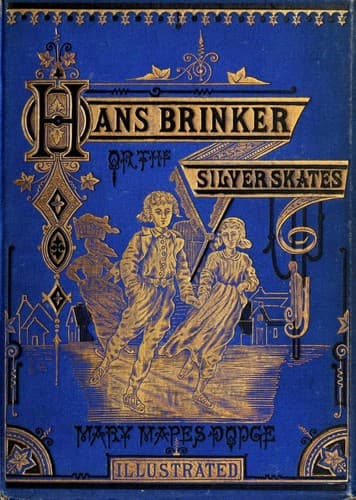
Hans Brinker; Or, The Silver SkatesDodge, Mary Mapes
History
Hans Brinker; Or, The Silver Skates
Dodge, Mary Mapes
Netherlands -- History -- 19th century -- Juvenile fiction; Siblings -- Juvenile fiction; Skating -- Juvenile fiction
Sir William Temple, in his Memoirs of "What passed in Christendom from
1672 to 1679," tells a story of a pompous magistrate going to visit a
lady of Amsterdam. A stout Holland lass opened the door, and told him in
a breath that the lady was at home and that his shoes were not very
clean. Without another word, she took the astonished man up by both
arms, threw him across her back, carried him through two rooms, set him
down at the bottom of the stairs, seized a pair of slippers that stood
there and put them upon his feet. Then, and not until then, she spoke,
telling him that her mistress was on the floor above, and that he might
go up.
While Ben was skating, with his friends, upon the crowded canals of the
city, he found it difficult to believe that the sleepy Dutchmen he saw
around him, smoking their pipes so leisurely, and looking as though
their hats might be knocked off their heads without their making any
resistance, were capable of those outbreaks that had taken place in
Holland--that they were really fellow-countrymen of the brave, devoted
heroes of whom he had read in Dutch history.
As his party skimmed lightly along he told Van Mounen of a burial-riot
which in 1696 had occurred in that very city, where the women and
children turned out, as well as the men, and formed mock funeral
processions through the town, to show the burgomasters that certain new
regulations, with regard to burying the dead, would not be acceded
to--how at last they grew so unmanageable, and threatened so much damage
to the city that the burgomasters were glad to recall the offensive law.
"There's the corner," said Jacob, pointing to some large buildings,
"where, about fifteen years ago, the great corn-houses sank down in the
mud. They were strong affairs, and set up on good piles, but they had
over seventy thousand hundred-weight of corn in them; and that was too
much."
It was a long story for Jacob to tell and he stopped to rest.
"How do you know there were seventy thousand hundred-weight in them?"
asked Carl sharply--"you were in your swaddling clothes then."
"My father knows all about it," was Jacob's suggestive reply. Rousing
himself with an effort, he continued--"Ben likes pictures. Show him
some."
"All right," said the captain.
"If we had time, Benjamin," said Lambert van Mounen in English, "I
should like to take you to the City Hall or _Stadhuis_. There are
building-piles for you! It is built on nearly fourteen thousand of
them, driven seventy feet into the ground. But what I wish you to see
there is the big picture of Van Speyk blowing up his ship--great
picture."
"Van _who_?" asked Ben.
"Van Speyk. Don't you remember? He was in the height of an engagement
with the Belgians, and when he found that they had the better of him and
would capture his ship, he blew it up, and himself too, rather than
yield to the enemy."
"Wasn't that Van Tromp?"
Public-domain text, read in full here on John Shaqi.
Reviews
Reviews
No reviews yet
Be the first to share your thoughts on this work.
Join the Discussion
Join the discussion
Sign in to leave a comment or review.
Sign InorCreate an account