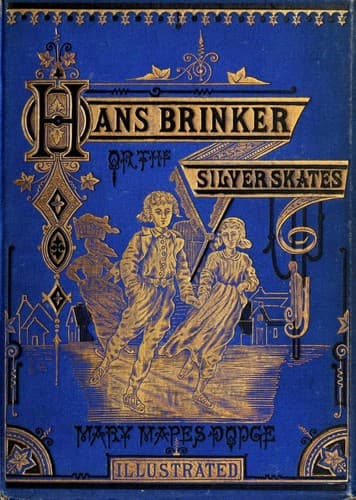
Hans Brinker; Or, The Silver SkatesDodge, Mary Mapes
History
Hans Brinker; Or, The Silver Skates
Dodge, Mary Mapes
Netherlands -- History -- 19th century -- Juvenile fiction; Siblings -- Juvenile fiction; Skating -- Juvenile fiction
Mr. Mackay in his "Memoirs of Popular Delusions" tells a funny story of
an English botanist who happened to see a tulip bulb lying in the
conservatory of a wealthy Dutchman. Ignorant of its value, he took out
his penknife and, cutting the bulb in two, became very much interested
in his investigations. Suddenly the owner appeared, and pouncing
furiously upon him, asked him if he knew what he was doing. "Peeling a
most extraordinary onion," replied the philosopher. "Hundert tousant
tuyvel!" shouted the Dutchman, "it's an Admiral Vander Eyk!" "Thank
you," replied the traveler, immediately writing the name in his note
book; "pray are these very common in your country?" "Death and the
tuyvel!" screamed the Dutchman, "come before the Syndic and you shall
see!" In spite of his struggles the poor investigator, followed by an
indignant mob, was taken through the streets to a magistrate. Soon he
learned to his dismay that he had destroyed a bulb worth 4,000 florins
($1,600). He was lodged in prison until securities could be procured for
the payment of the sum.]
"Ha! ha! that's true, unless you are over two hundred years old. Well, I
tell you, sir, there was never anything like it before nor since. Why,
persons were so crazy after tulip bulbs in those days, that they paid
their weight in gold for them."
"What, the weight of a man?" cried Ben, showing such astonishment in his
eyes, that Ludwig fairly capered.
"No, no, the weight of a _bulb_. The first tulip was sent here from
Constantinople about the year 1560. It was so much admired that the rich
people of Amsterdam sent to Turkey for more. From that time they grew to
be the rage, and it lasted for years. Single roots brought from one to
four thousand florins; and one bulb, the Semper Augustus, brought
fifty-five hundred."
"That's more than four hundred guineas of our money," interposed Ben.
"Yes, and I know I'm right, for I read it in a translation from
Beckman, only day before yesterday. Well, sir, it was great. Every one
speculated in Tulips, even the barge-men and rag-women, and
chimney-sweeps. The richest merchants were not ashamed to share the
excitement. People bought bulbs and sold them again at a tremendous
profit without ever seeing them. It grew into a kind of gambling. Some
became rich by it in a few days, and some lost everything they had.
Land, houses, cattle and even clothing went for Tulips when people had
no ready money. Ladies sold their jewels and finery to enable them to
join in the fun. Nothing else was thought of. At last the States-general
interfered. People began to see what geese they were making of
themselves, and down went the price of Tulips. Old tulip debts couldn't
be collected. Creditors went to law, and the law turned its back upon
them; debts made in gambling were not binding, it said. Then, there was
a time! Thousands of rich speculators reduced to beggary in an hour. As
old Beckman says, 'the bubble was burst at last.'"
Public-domain text, read in full here on John Shaqi.
Reviews
Reviews
No reviews yet
Be the first to share your thoughts on this work.
Join the Discussion
Join the discussion
Sign in to leave a comment or review.
Sign InorCreate an account