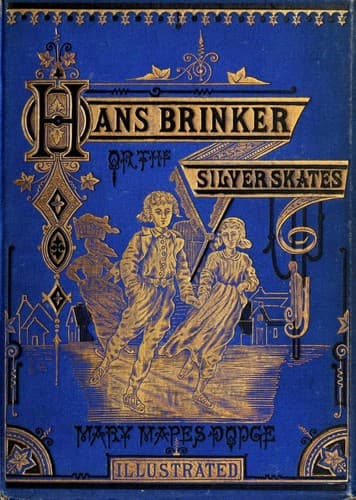
Hans Brinker; Or, The Silver SkatesDodge, Mary Mapes
History
Hans Brinker; Or, The Silver Skates
Dodge, Mary Mapes
Netherlands -- History -- 19th century -- Juvenile fiction; Siblings -- Juvenile fiction; Skating -- Juvenile fiction
As soon as the children turned from the canal they could see their
parents' cottage. Their mother's tall form, arrayed in jacket and
petticoat and close-fitting cap, stood, like a picture, in the crooked
frame of the doorway. Had the cottage been a mile away, it would still
have seemed near. In that flat country every object stands out plainly
in the distance; the chickens show as distinctly as the windmills.
Indeed, were it not for the dykes and the high banks of the canals, one
could stand almost anywhere in middle Holland without seeing a mound or
a ridge between the eye and the "jumping-off place."
None had better cause to know the nature of these same dykes than Dame
Brinker and the panting youngsters now running at her call. But before
stating why, let me ask you to take a rocking-chair trip with me to that
far country where you may see, perhaps for the first time, some curious
things that Hans and Gretel saw every day.
II
HOLLAND
Holland is one of the queerest countries under the sun. It should be
called Odd-land or Contrary-land, for in nearly everything it is
different from other parts of the world. In the first place, a large
portion of the country is lower than the level of the sea. Great dykes
or bulwarks have been erected at a heavy cost of money and labor, to
keep the ocean where it belongs. On certain parts of the coast it
sometimes leans with all its weight against the land, and it is as much
as the poor country can do to stand the pressure. Sometimes the dykes
give way, or spring a leak, and the most disastrous results ensue. They
are high and wide, and the tops of some of them are covered with
buildings and trees. They have even fine public roads upon them, from
which horses may look down upon wayside cottages. Often the keels of
floating ships are higher than the roofs of the dwellings. The stork
clattering to her young on the house-peak may feel that her nest is
lifted far out of danger, but the croaking frog in neighboring bulrushes
is nearer the stars than she. Water-bugs dart backward and forward above
the heads of the chimney swallows; and willow trees seem drooping with
shame, because they cannot reach as high as the reeds near by.
Ditches, canals, ponds, rivers and lakes are everywhere to be seen.
High, but not dry, they shine in the sunlight, catching nearly all the
bustle and the business, quite scorning the tame fields stretching
damply beside them. One is tempted to ask, "Which is Holland--the shores
or the water?" The very verdure that should be confined to the land has
made a mistake and settled upon the fish-ponds. In fact the entire
country is a kind of saturated sponge or, as the English poet, Butler,
called it,
"A land that rides at anchor, and is moor'd,
In which they do not live, but go aboard."
Public-domain text, read in full here on John Shaqi.
Reviews
Reviews
No reviews yet
Be the first to share your thoughts on this work.
Join the Discussion
Join the discussion
Sign in to leave a comment or review.
Sign InorCreate an account