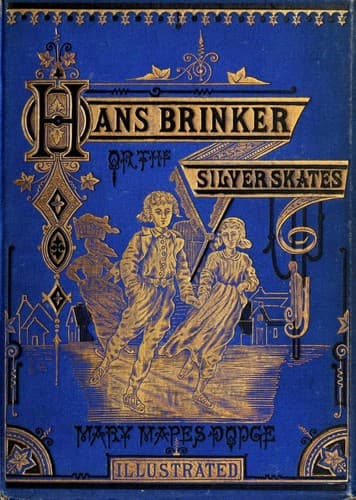
Hans Brinker; Or, The Silver SkatesDodge, Mary Mapes
History
Hans Brinker; Or, The Silver Skates
Dodge, Mary Mapes
Netherlands -- History -- 19th century -- Juvenile fiction; Siblings -- Juvenile fiction; Skating -- Juvenile fiction
"Van Mounen! they say the very carrier-pigeons that brought news of
relief to the besieged city are somewhere here in Leyden. I really
should like to see them. Just think of it! At the very height of the
trouble if the wind didn't turn, and blow in the waters, and drown
hundreds of the Spaniards, and enable the Dutch boats to sail in right
over the land with men and provisions to the very gates of the city. The
pigeons, you know, did great service, in bearing letters to and fro. I
have read somewhere that they were reverently cared for from that day,
and, when they died, they were stuffed, and placed for safe keeping in
the Town Hall. We must be sure to have a look at them."
Van Mounen laughed. "On that principle, Ben, I suppose when you go to
Rome you'll expect to see the identical goose who saved the Capitol. But
it will be easy enough to see the pigeons. They are in the same building
with Van der Werf's portrait. Which was the greatest defence, Ben, the
siege of Leyden or the siege of Haarlem?"
"Well," replied Ben, thoughtfully, "Van der Werf is one of my heroes; we
all have our historical pets, you know, but I really think the siege of
Haarlem brought out a braver, more heroic resistance even, than the
Leyden one; besides they set the Leyden sufferers an example of courage
and fortitude, for their turn came first."
"I don't know much about the Haarlem siege," said Lambert, "except that
it was in 1573. Who beat?"
"The Spaniards," said Ben. "The Dutch had stood out for months. Not a
man would yield nor a woman either for that matter. They shouldered arms
and fought gallantly beside their husbands and fathers. Three hundred of
them did duty under Kanau Hesselaer, a great woman, and brave as Joan of
Arc. All this time the city was surrounded by the Spaniards under
Frederic of Toledo, son of that beauty, the Duke of Alva. Cut off from
all possible help from without, there seemed to be no hope for the
inhabitants, but they shouted defiance over the city walls. They even
threw bread into the enemy's camps to show that they were not afraid of
starvation. Up to the last they held out bravely, waiting for the help
that never could come--growing bolder and bolder until their provisions
were exhausted. Then it was terrible. In time hundreds of famished
creatures fell dead in the streets, and the living had scarcely strength
to bury them. At last, they made the desperate resolution, that rather
than perish by lingering torture, the strongest would form in a square,
placing the weakest in the centre, and rush in a body to their death,
with the faint chance of being able to fight their way through the
enemy. The Spaniards received a hint of this, and believing there was
nothing the Dutch would not dare to do, they concluded to offer terms."
"High time, I should think."
Public-domain text, read in full here on John Shaqi.
Reviews
Reviews
No reviews yet
Be the first to share your thoughts on this work.
Elsewhere in the archive
Join the Discussion
Join the discussion
Sign in to leave a comment or review.
Sign InorCreate an account