Happiness: Essays on the meaning of lifeHilty, Karl
Philosophy
Happiness: Essays on the meaning of life
Hilty, Karl
Conduct of life; Happiness
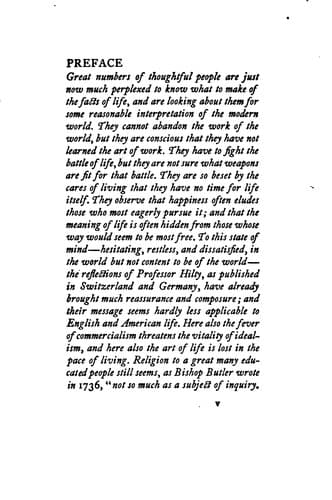
it will not be tempted by an ecclesiastical omniscience. It demands
sanity, reserve, wisdom, and insight, a competent witness of the things
of the Spirit. This is the state of mind to which this little book
is addressed. The author makes his appeal not to discussion, but to
life. He reports the story of a rational experience. He walks with
confidence because he knows the way. He accepts the saying of Pico
della Mirandola: “Philosophia veritatem quaerit, ... religio possidet.”
Let us take life, he says, just as it is and must be, and observe that
the doors which lead into its inner meaning open only to the key of a
reasonable faith._
_It might be fancied that a writer thus described must be a recluse
or mystic, remote from the spirit of the modern world and judging
experiences which he does not share. Quite the contrary is the fact.
The philosophy of life which he teaches is wrought out of large
experience, both of academic and political affairs, and that which
draws readers to the author is his capacity to maintain in the midst of
important duties of public service an unusual detachment of desire and
an interior quietness of mind. His short Essays are the Meditations of
Marcus Aurelius, told in the language of modern life; the Imitation of
Christ, expressed with the academic reserve of a modern gentleman._
_Some years ago I obtained permission from Professor Hilty to translate
for English and American readers a few of these Essays which had
found such acceptance in Switzerland and Germany; and the present
volume, containing his first series, has been a pleasant occupation of
some vacation days. I have found it necessary, however, to use much
freedom in dealing with his idiomatic and epigrammatic style, and have
perhaps exceeded the legitimate right of a translator in the attempt
to reproduce the tone and temper of the author. Nothing, I think, is
here which Professor Hilty has not said; but there are many shiftings
of phrase and many ruptures of German sentences; and here and there
a passage has been omitted which seemed important to Swiss readers
only. The Essay on Epictetus, being rather a compilation and review
than an illustration of Hilty’s own philosophy of life, is omitted;
as are also the copious and discursive footnotes which enrich the
original. I trust that these liberties and omissions may not obscure
the qualities of Professor Hilty’s mind--its insight, sagacity, humor,
and devoutness--which no one who has had the privilege of his personal
acquaintance can recall without affection and gratitude._
FRANCIS G. PEABODY.
_Cambridge, Massachusetts, October 15, 1902._
NOTE
Public-domain text, read in full here on John Shaqi.
Reviews
Reviews
No reviews yet
Be the first to share your thoughts on this work.
Join the Discussion
Join the discussion
Sign in to leave a comment or review.
Sign InorCreate an account