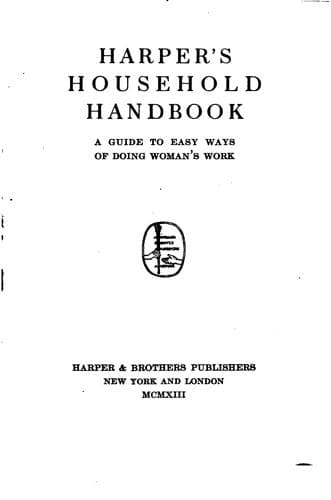
Harper's Household Handbook: A guide to easy ways of doing woman's workMcCulloch-Williams, Martha
General
Harper's Household Handbook: A guide to easy ways of doing woman's work
McCulloch-Williams, Martha
Formulas, recipes, etc.; Home economics
Furs worn in dusty wind or a foul atmosphere need to be well combed,
brushed against the grain, and aired quickly. Dry wet furs in air, but
away from heat. Stretch and knead them several times while drying to
keep the skin pliable. Shake hard at first, hang smooth, and let drain.
Unless very wet, only dampness will reach the skin if they are so
treated. Snow shaken off before melting is a help rather than a hurt.
Indeed, a good way to clean fur rugs is to drag them, hair down, over
dry snow. Clean on the floor by sprinkling thickly with hot meal or
sawdust, rubbing in well and brushing out, then combing.
------------------------------------------------------------------------
VI
MAKING AND MAKING OVER
Wherewithal to make of is the first requisite. Here follow some simple
tests easily applicable and well worth while. Use upon samples, and buy
accordingly. Things over-cheap, it may be said in passing, carry their
condemnation in their price. Buying them is extravagance, since they
cost as much in time, trouble, and often in money for making up as sound
stuffs and make no adequate return in wear.
=Silk=: Test silk three ways—by tearing, scraping with the thumb nail,
and burning. Try to tear a raw edge across the filling. If it is easily
done the filling is either artificial or so loaded it will give no wear.
Weak warp is even worse—with warp and filling both easily rent, the
stuff is wholly bad. Pull out a few threads both ways and test their
strength separately. Easy breaking means that they are loaded with
earthy or metal salts to give weight and firmness without wear. Scrape
the surface diagonally with the thumb nail. If threads slip under the
scraping, let that particular silk alone. Rub well between the
fingers—pure silk feels smooth and soft; that which is loaded, crisp,
even harsh. Some silks have the face pure, the back loaded—wherefore
test both sides. End by burning a bit. Real silk does not burn readily,
and leaves a black ash. Weighted or loaded silk flashes up, burns
swiftly, and leaves behind a dull-red ash.
=Woolens=: Test by raveling out and burning. Untwist a raveled
thread—fibers of even, moderate length show pure wool. If there are a
few fibers with clots all along them the cloth is most shoddy—that is to
say, old wool ground up and mixed before spinning with a little new.
After-treatment makes it look well, but there is mighty little wear.
Snap a raveling between the hands—the harder the breaking the better the
goods. Soak a few threads in a little alcohol. This to test the color. A
tinge in the alcohol is to be expected, but if it becomes deep-colored,
and especially if it becomes muddy, the dyeing is bad. Cotton mixture
before spinning betrays itself in burning. Light a few threads or a
snippet—the smell will tell the truth.
Public-domain text, read in full here on John Shaqi.
Reviews
Reviews
No reviews yet
Be the first to share your thoughts on this work.
Join the Discussion
Join the discussion
Sign in to leave a comment or review.
Sign InorCreate an account